Heat Pump Making a Weird Noise? A Sound-by-Sound Guide
Grinding, screeching and steady hissing mean stop using the system. Buzzing, clicking and rattling usually don't. Here's every common heat pump noise, what it means, and how urgent it is.

Match the sound, then decide whether to keep running it
Buzzing usually means electrical. Screeching or grinding means a bearing, and you should shut the system down. Hissing means a possible refrigerant leak and deserves a call today. Rattles and clanks are usually mechanical and often cheap. Here’s every common sound, decoded.
Grinding, screeching, and hissing are the three sounds that mean stop using the system and call a technician. Buzzing, repeated clicking, rattling, banging, and gurgling are worth a call soon but usually not an emergency. A whoosh and a hiss of steam during winter defrost is normal.
The fastest way to get this right is to note three things before you call anyone: what the sound is like, where it comes from (outdoor unit, indoor air handler, or ductwork), and when it happens (at startup, during the whole run, at shutdown, or only in winter). Those three details narrow most problems down to one or two causes. 💡
This guide is about sounds that mean something is wrong. If your question is how loud a heat pump is supposed to be in normal operation — decibel ratings, what 55 dB sounds like on a patio, how to quiet a unit that’s simply audible — that’s a different question, and our guide to heat pump noise levels covers it. Everything below assumes the noise is new, unusual, or getting worse.
One thing to do before you read further: record it. Pull out your phone, stand near the unit, and capture 20 or 30 seconds of the sound. Technicians will tell you that half the noise complaints they’re sent to investigate have gone quiet by the time they arrive. A recording turns “it makes a weird sound sometimes” into something diagnosable, and it costs you nothing.
What’s in this guide
- The sound-to-urgency table
- When to shut it down immediately
- Buzzing or humming
- Clicking
- Screeching or squealing
- Grinding
- Rattling and vibration
- Gurgling or bubbling
- Hissing
- Banging or clanking
- Sounds that are supposed to happen
- What noise repairs typically cost
- 6 mistakes people make with a noisy unit
- Frequently asked questions
- Your final checklist
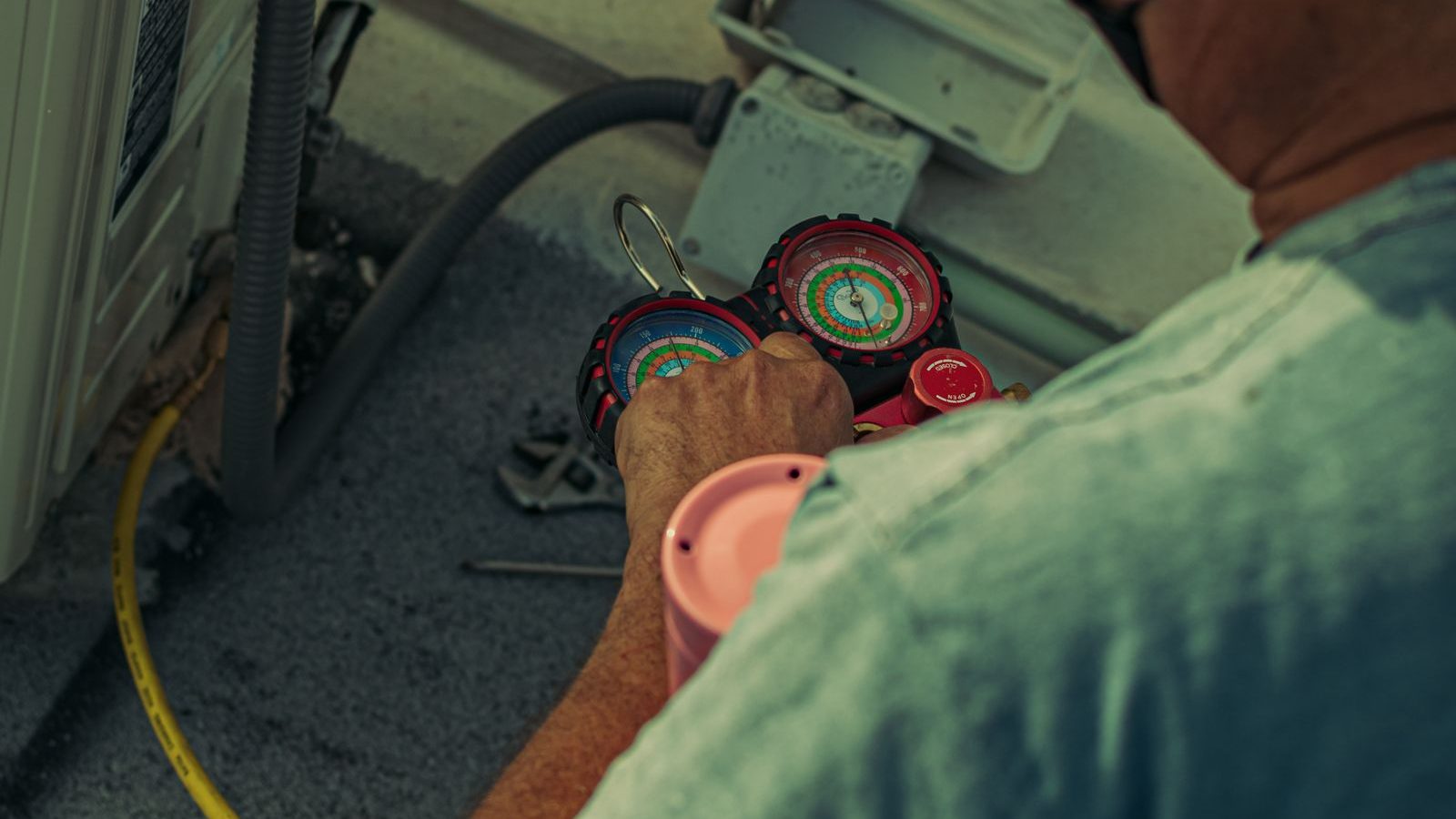
Alt text: “Homeowner recording an unusual noise coming from an outdoor heat pump unit”
The sound-to-urgency table
Find the closest match to what you’re hearing. The urgency column is the important one — it tells you whether this is a weekend project, a call on Monday, or a stop-right-now.
| Sound | Usual cause | Urgency | DIY or pro |
|---|---|---|---|
| Low buzz or hum, constant | Contactor chatter, loose panel resonating, failing capacitor | Keep using, call this week | Panel screws DIY; electrical is pro |
| Single click at start and stop | Relay or contactor operating normally | Normal | Nothing to do |
| Repeated clicking, no start | Failed start components, control fault | Stop using, call soon | Pro |
| Screech or squeal | Fan or blower motor bearing failing; belt on older air handlers | Stop using, call now | Pro |
| Grinding, metal on metal | Motor bearings failing, debris in the blower wheel | Stop using, call now | Pro |
| Rattle or buzz-vibration | Loose panel, loose mount, twigs or leaves in the fan | Keep using if mild, inspect | Often DIY with power off |
| Gurgling or bubbling | Refrigerant flow; possibly low charge or non-condensables | Call soon if new or constant | Pro |
| Hissing that doesn’t stop | Refrigerant leak; sometimes a duct or valve leak | Stop using, call now | Pro, EPA-certified |
| Bang or clank at startup | Loose compressor mount, fan blade striking, hard-starting compressor | Stop using if repeated, call soon | Pro |
| Whoosh and steam in winter | Defrost cycle running | Normal | Nothing to do |
When to shut it down immediately
Most heat pump noises are annoying rather than dangerous. Three categories aren’t, and it’s worth being clear about them before we get into the sound-by-sound detail.
Grinding or screeching from a motor. Both sounds mean metal is contacting metal where it shouldn’t. A bearing that’s screeching is a bearing that’s about to seize. If it seizes while the motor is energized, the motor windings can overheat, and a burned-out motor is a much larger bill than a bearing or a motor replaced before failure. It’s also a fire risk in the worst case. Shut it off at the thermostat, then at the outdoor disconnect or the breaker, and leave it off.
A steady hiss you can’t explain. Refrigerant escaping through a small opening makes a hiss as it drops from high pressure to low. Running a system with a leak means running a compressor with too little refrigerant to cool and lubricate it properly, which is one of the fastest ways to destroy the most expensive component you own. It also releases refrigerant into the atmosphere, which is both wasteful and, done knowingly, illegal.
Anything accompanied by burning smells, smoke, or repeated breaker trips. That’s no longer a noise problem. Shut off power at the breaker and call a licensed technician or electrician.
Residential equipment shipping since 2025 uses R-454B or R-32 — A2L refrigerants classed as mildly flammable. They’re safe in normal use and new systems include leak sensors that shut the equipment down automatically, but if you suspect a leak from an indoor unit, ventilate the space, keep open flames and sparks away, don’t run the system, and call a licensed technician. Never try to locate a leak with a lighter or a flame-based tool. Our R-454B transition guide explains what’s different about these refrigerants.
If you’re going to open a panel or reach into a cabinet, turn the system off at the thermostat, then pull the outdoor disconnect (the box on the wall near the unit) or switch off the circuit breaker. Capacitors hold a dangerous charge even after power is removed, so do not touch internal electrical components regardless. Homeowner-appropriate work here means panel screws, visible debris, and mounting hardware — nothing electrical.
Buzzing or humming
Buzzing is the most reported abnormal heat pump sound, and it has three common sources that feel similar but mean different things.
Contactor chatter. The contactor is the heavy relay inside the outdoor unit that connects line power to the compressor. When its contacts pit and burn over years of switching, or when the low-voltage signal driving it is weak, it makes and breaks contact rapidly — a hard, electrical buzz rather than a mechanical one. You’ll usually hear it as a persistent, slightly irregular buzz from inside the cabinet, sometimes with the compressor failing to start cleanly. Contactors are also a favorite nesting spot for ants, which sounds like a joke and isn’t. This is a straightforward, inexpensive repair for a technician.
A failing run capacitor. A weak capacitor can’t give the motor the electrical push it needs, so the motor draws high current and hums instead of turning cleanly. The classic sign is a compressor that hums for a few seconds at startup, doesn’t get going, and then trips off. If your system is also starting and stopping too often, read our guide to heat pump short cycling, because a failing capacitor sits behind both symptoms. Capacitors store enough energy to hurt you badly even when the power is off — this is a pro job, and a cheap one.
A loose panel resonating. This one you can often fix yourself. Sheet metal panels vibrate at the frequency of the compressor or fan, and a panel with a missing or loosened screw turns into a speaker. It sounds mechanical and buzzy rather than electrical, and it often changes pitch as the compressor speed changes on an inverter unit. With power off at the disconnect, go around the cabinet and snug every panel screw. If a screw hole is stripped, a slightly larger self-tapping screw usually solves it.
A faint buzz coming from the wall thermostat or the air handler’s low-voltage section usually means a failing transformer or a shorted thermostat wire, not a compressor problem. It’s low voltage, but it still belongs to a technician — and it’s often behind erratic system behavior as well as the noise.
How to tell them apart from outside: an electrical buzz stays roughly the same pitch and comes from a specific point inside the cabinet. A panel buzz changes when you press a hand against the panel. That’s a legitimate test — press gently on the cabinet sides while it’s running and see whether the noise changes.
Clicking
Not all clicking is bad, and the difference is entirely about whether it repeats.
One click at startup, one at shutdown. That’s the contactor or a relay doing exactly what it’s designed to do — a crisp, single mechanical snap as contacts close or open. Every heat pump does this. Some are louder than others. It’s normal and needs nothing.
Repeated clicking with no start. Click, pause, click, pause, and the compressor never comes to life. This means the system is trying to start and something is preventing it. The usual causes are a dead or dying capacitor, a failed contactor, a compressor that’s seized or on internal overload, or a control board that’s cycling through a fault. Repeated clicking without a successful start also means the system is drawing inrush current over and over without producing heating or cooling, so there’s no reason to leave it running while you wait for service.
Clicking that comes from the indoor unit. On ducted systems, the ductwork itself expands and contracts as it heats and cools, which produces ticking and popping — usually one or two noises shortly after startup and again after shutdown, not a rhythm. That’s thermal movement, and it’s normal. Rigid metal ducts do it more than flex. If it’s genuinely bothersome, a contractor can sometimes address it with additional strapping or by breaking up long unsupported runs.
Two clicks per cycle is machinery. Ten clicks in twenty seconds is a fault. If you can count a repeating rhythm, that’s the system attempting something over and over — which is worth investigating rather than tuning out.
Screeching or squealing
A high-pitched squeal or metallic screech that rises with fan speed is one of the sounds you should treat seriously, and it almost always traces to a rotating part.
Fan or blower motor bearings. Motors ride on bearings, and bearings wear. As lubrication breaks down and clearances open up, you get a high, thin squeal that’s usually worst at startup and may quiet down once things warm up — which fools people into thinking it fixed itself. It didn’t. A screeching bearing is on a countdown, and the endpoint is a seized motor. Replacing a bearing or the motor before it seizes is materially cheaper than replacing a motor that failed under load and possibly took something else with it.
A belt, on older air handlers. Most residential equipment built in the last few decades uses direct-drive blowers with no belt at all. But belt-driven blowers still exist in older air handlers and some larger equipment, and a worn or misaligned belt makes a distinctive rubbery squeal, often loudest for the first few seconds of a run. If your air handler is genuinely old, this is worth checking. If it’s modern, there’s no belt and you’re looking at a bearing.
Very high pressure in the refrigerant circuit. Rarer, but a system running at abnormally high pressure can produce a scream from the compressor or from a relief device. This one is unmistakably alarming and should be treated as a shut-it-down-now situation.
The practical rule: if a squeal is new, or it’s getting louder week over week, or it changes with fan speed, shut the system down and get it looked at. This is not a sound to live with through a season.
A bearing that squeals is telling you how much time you have left. A bearing that grinds has already spent it.
— The reason technicians push for early motor replacement
Grinding
Grinding is the sound of metal wearing directly against metal, and it’s the most urgent mechanical noise on this list.
The usual source is a motor bearing that has passed the squealing stage. Lubrication is gone, the shaft is riding on the race, and the sound is a rough, low, gritty noise rather than a high squeal. Once it’s grinding, seizure isn’t a distant possibility — it’s the next step. When a motor seizes with power applied, the windings can overheat within seconds to minutes, and a burnt motor is both more expensive and, if the failure is bad enough, a genuine fire hazard.
The other source is debris in the blower wheel or fan. Something rigid — a fragment of insulation, a piece of a filter that came apart, a small branch in the outdoor fan — gets into the airflow path and drags against the housing. That can also produce grinding, and it can bend fan blades or throw the wheel out of balance, which then damages the bearings and turns a small problem into a large one.
Either way, the response is the same: shut it off, leave it off, and call. There is no version of this where continuing to run the system makes things better. If the grinding is coming from the outdoor unit and you can see through the fan grille, it’s reasonable to look for obvious debris after cutting power at the disconnect — but the moment you’d need to open a panel or reach past the grille, you’re past the homeowner boundary.
Turn the system off at the thermostat, then pull the outdoor disconnect or switch off the breaker, and leave it off until a technician has looked at it. If it’s cold out and you have auxiliary or emergency heat available, use that in the meantime — our guide to emergency and auxiliary heat explains how to run it without wrecking your bill.
Rattling and vibration
Rattling is the most common annoying-but-benign category, and it’s the one homeowners are most likely to solve themselves.
Loose panel or missing screws. Same story as the buzzing section, at a lower frequency. Vibration works fasteners loose over years, and once a panel can move, it drums. With power off at the disconnect, tighten everything you can reach.
Mounting bracket or pad resonance. Outdoor units sit on a pad or, for wall-mounted and mini-split condensers, on a bracket. If the pad has settled unevenly, or the bracket is bolted to a wall stud that transmits vibration into the structure, the whole house can pick up a low hum or buzz that seems to come from everywhere. Anti-vibration pads under the unit’s feet, or isolation grommets on a wall bracket, often solve this for very little money. Getting the pad level again may need a contractor, but it’s not complicated work. This is also worth checking on ductless installs, where a bracket bolted directly to a bedroom wall is a well-known regret — our guide to ducted vs. ductless systems touches on placement decisions.
Debris in the fan. Twigs, leaves, plastic bags, and — in autumn — an impressive volume of seed pods find their way into outdoor cabinets. A light rattle that changes as the fan speeds up or slows down often means something loose is bouncing around in there. Power off at the disconnect, look through the grille with a flashlight, and remove what you can reach without disassembly.
Ductwork rattle. If the noise is inside the house rather than at the equipment, thin sheet metal duct can oil-can — flex in and out — as pressure changes at startup. Additional strapping or a small amount of stiffening usually fixes it. High static pressure makes it worse, which is another reason to have that measured if you’re chasing several symptoms at once.
With the system running, rest your palm firmly on different panels and surfaces one at a time. When the noise changes or stops, you’ve found the resonating part. Do this on exterior cabinet panels only, never near the fan grille or anywhere your fingers could reach a moving part.
Gurgling or bubbling
Gurgling is the sound of liquid and vapor moving together, and in a heat pump there are two liquids it could be.
Refrigerant. Some gurgle is normal — refrigerant changes state as it moves through the system, and you’ll often hear a brief gurgle or trickle right after shutdown as pressures equalize, especially on ductless heads. A gurgle that’s constant, loud, or new is different. It can indicate a low charge, where vapor bubbles form in what should be a solid column of liquid refrigerant, or non-condensable gases in the system from a poor evacuation during installation or service. Both are technician territory, and both are worth catching early because a system running low on charge is a system wearing out its compressor.
Condensate. Gurgling from the indoor unit can also just be water in the condensate drain — particularly if the drain lacks a proper trap, in which case the blower’s pressure can pull air through the water and make it burble. That’s more of a plumbing detail than an equipment fault, but it often shows up alongside drainage problems. If you’re also seeing water where it shouldn’t be, our guide to a heat pump leaking water covers drains, traps, and pans in detail.
Distinguishing the two by ear is genuinely hard. The useful clues are timing and location: condensate gurgling usually comes from the drain side of the indoor unit and is more noticeable in humid cooling weather, while refrigerant gurgling comes from the line set or the coil itself and often accompanies weaker heating or cooling. If the system’s performance has slipped at all, assume refrigerant and get it measured.
Hissing
Take this one seriously. Hissing is the sound that most often means refrigerant is escaping.
When refrigerant leaks through a small opening — a corroded spot on a coil, a bad flare connection, a cracked joint on the line set — it expands rapidly from high pressure to low, and that expansion makes a hiss. It can be faint enough that you only notice it when the house is quiet, and it can come from the indoor coil, the outdoor unit, or anywhere along the line set between them. Formicary corrosion, which produces microscopic pinhole leaks in evaporator coils, is a known failure mode on aluminum and copper coils and can produce a leak with no visible damage at all.
The supporting signs that turn “maybe” into “probably”: heating or cooling that’s gotten weaker over months rather than failing suddenly, ice on the smaller copper line at the outdoor unit, an oily residue at a joint (refrigerant carries oil, so a leak often leaves a stain), and the system running much longer than it used to for the same result. Any two of those alongside a hiss and you should stop running the system.
Two hissing sounds that aren’t leaks. A brief hiss right at shutdown is normal pressure equalization. And a hiss coming from the ductwork rather than the equipment is usually air escaping a duct joint or being forced through a partially blocked register — that’s an airflow problem, not a refrigerant problem, though it’s still costing you money.
Refrigerant doesn’t get consumed. If a system is low, it leaked, and adding more without finding and repairing the leak means you’ll be doing it again — while the compressor runs undercharged in the meantime. Ask for leak detection, a location, and a repair method in writing before you pay for refrigerant. With R-410A being phased down, top-offs on older systems are getting more expensive every year, which changes the repair-versus-replace math.
Banging or clanking
A hard bang or clank is a mechanical impact, and the question is what’s hitting what.
Loose compressor mounting. Compressors sit on rubber isolation grommets that absorb the jolt of startup. Those grommets harden and crack with age and UV exposure, and once they’ve failed, the compressor can shift and slam against the cabinet or its own mounting bolts at startup. The sound is a single heavy thud, usually right as the unit comes on. Left alone, that repeated impact fatigues refrigerant lines and mounting hardware.
A fan blade striking something. If a blade is bent — by hail, by debris, or by someone leaning something against the unit — it can clip the shroud or a wire on each rotation, producing a rhythmic clank at fan speed. Bent blades also throw the fan out of balance, which chews through motor bearings, so this one escalates.
A hard-starting or failing compressor. An internal clank or a heavy knock at startup can mean internal wear or liquid refrigerant reaching the compressor where only vapor should be. Neither is something to run through. A compressor is typically the single most expensive component in the system, and by the time it’s making noise, the conversation often shifts from repair to whether the age of the system justifies replacement — our 2026 cost guide is a useful reference for that math.
One clank after a power outage or a long shutdown is often just the system settling. A bang that happens on every single startup is a mounting or mechanical fault that’s fatiguing hardware a little more each time. Once you can predict it, stop running the system and get it looked at.
Ductwork booming. Inside the house, a hollow boom at startup or shutdown is usually a large flat section of duct flexing as pressure changes. It’s harmless but fixable with stiffening or additional support.
Sounds that are supposed to happen
Before you spend money, make sure the sound isn’t the machine working correctly.
The defrost whoosh. Several times a day in cold, damp weather, a heat pump reverses itself briefly to melt frost off the outdoor coil. What you’ll hear: the outdoor fan stops, there’s a distinct whoosh or clunk as the reversing valve shifts, the compressor note changes, and a few minutes later the fan restarts with another whoosh. What you’ll see: steam rising off the unit, which people regularly mistake for smoke. It’s completely normal, it usually lasts a few minutes, and our guide to frost and ice on heat pumps explains what normal defrost should look like and when ice actually indicates a fault.
The reversing valve shift. Any time the system switches between heating and cooling — including at the start and end of a defrost — the reversing valve makes a whoosh or a soft clunk. Some models are noticeably louder than others.
The startup ramp on inverter equipment. Variable-speed systems change pitch as the compressor speeds up and slows down. That rising and falling note is the whole point of the technology, not a fault.
A brief refrigerant trickle after shutdown. Pressures equalizing. Very common on ductless heads.
Ordinary running noise. A heat pump is a fan and a compressor outdoors, and both make sound. If your complaint is that the unit is simply audible from the patio or a bedroom window rather than that it’s making a new noise, the fix is placement, sound blankets, or barriers, and that’s covered in our noise levels guide and our roundup of the quietest heat pumps.
Alt text: “Steam rising from an outdoor heat pump during a normal winter defrost cycle”
What noise repairs typically cost
Ranges below are typical 2026 national figures for residential air-source equipment. Your region, equipment age, and refrigerant type move these numbers significantly.
| Repair | Typical cost | Sound it fixes |
|---|---|---|
| Tightening panels, clearing debris | Free | Rattle, buzz-vibration |
| Anti-vibration pads or isolation grommets | $20–$120 | Low hum transmitted into the house |
| Diagnostic service call | $100–$250 | Any sound you can’t place |
| Run capacitor replacement | $150–$400 | Humming, buzzing, failed starts |
| Contactor replacement | $150–$400 | Electrical buzz, chatter, repeated clicking |
| Compressor isolation grommets | $150–$450 | Banging at startup |
| Outdoor fan motor replacement | $400–$900 | Screeching, grinding at the outdoor unit |
| Blower motor replacement | $450–$1,500 | Screeching, grinding at the air handler |
| Leak repair plus recharge | $400–$2,000+ | Hissing, gurgling from low charge |
| Reversing valve replacement | $600–$1,600 | Failure to switch modes; not the normal whoosh |
| Compressor replacement | $1,500–$4,500+ | Internal knocking; often a replace-the-system decision |
One planning note: the federal 25C tax credit ended for property placed in service after 31 December 2025, so if a noise diagnosis turns into a replacement conversation, don’t budget for it. State and utility incentives are a separate matter and many are still active — see our 2026 rebates guide.
6 mistakes people make with a noisy unit
❌ Mistake 1: Waiting for the squeal to become a grind
A screeching bearing often gets quieter once the motor warms up, so people convince themselves it’s improving. It isn’t — the sound is telling you the bearing is nearly gone. Waiting turns a motor replacement into a motor replacement plus whatever the seizure damaged on its way out.
❌ Mistake 2: Spraying lubricant into the fan
Household penetrating oil is the wrong lubricant for a sealed motor bearing and it can’t get where it needs to go. It’ll quiet the noise for a day or two, attract dust, and leave you thinking the problem is solved. Meanwhile the bearing keeps failing.
❌ Mistake 3: Reaching into the cabinet without cutting power
People pull a twig out of the fan grille while the system is on standby, forgetting that a thermostat call can start that fan at any moment. Capacitors also hold a lethal charge after power is removed, so “it’s off” isn’t the same as “it’s safe.”
❌ Mistake 4: Wrapping the unit to muffle the sound
Blankets, plywood boxes, and tight enclosures around an outdoor unit block the airflow the equipment needs to reject or absorb heat. You’ll trade a noise complaint for high head pressure, short cycling, and a shorter compressor life.
❌ Mistake 5: Assuming the defrost noise is a breakdown
Every winter, technicians get emergency calls about steam, whooshing, and a fan that suddenly stopped. It’s the defrost cycle, and the visit is billable. Knowing what normal defrost sounds and looks like saves a real amount of money.
❌ Mistake 6: Not recording the sound before calling
Intermittent noises have a talent for going silent when a technician arrives. Without evidence, you pay for a visit that produces “couldn’t reproduce it,” and you’re back where you started when it returns.
❌ Mistake 7: Topping off refrigerant to quiet a hiss
Adding refrigerant makes the symptoms recede for a while, which feels like a fix. But the leak is still there, the charge will be low again, and you’ve paid for refrigerant that’s going into the atmosphere.
Frequently asked questions
Is it safe to keep running my heat pump while it makes noise?
It depends entirely on the sound. Rattles, mild buzzing, clicking at start and stop, and defrost whooshing are fine to run with while you arrange service. Grinding, screeching, and steady hissing are not — shut the system down at the thermostat and the disconnect and call a technician. If you smell burning or the breaker keeps tripping, leave the power off regardless of the noise.
Why is my heat pump suddenly louder than it used to be?
Gradual increases usually mean wear — bearings roughening, mounting grommets hardening, fasteners loosening. Sudden increases usually mean something changed physically: debris in the fan, a panel that came loose, a bent blade, or a failed part. If the change was abrupt, look for something visible first with the power off. If it crept up over months, it’s wear and worth a service visit.
What does a refrigerant leak sound like?
Usually a faint, steady hiss, sometimes a bubbling or gurgling from the coil or line set. It’s often quiet enough to miss unless the house is silent. The stronger clues are performance-related: weaker heating or cooling over months, ice on the small copper line at the outdoor unit, oily residue at a joint, and much longer run times for the same comfort. Any of those alongside a hiss means stop running it and call.
My outdoor unit clunks and steams in winter. Is it broken?
Almost certainly not. That’s the defrost cycle — the reversing valve shifting makes a whoosh or clunk, the outdoor fan stops, and melting frost produces steam that looks like smoke. It typically runs a few minutes and ends on its own. It becomes a problem only if ice keeps building despite defrosting, or the unit stays in defrost for very long stretches.
Can I fix a rattling noise myself?
Often yes, and it’s one of the few noise repairs that’s genuinely homeowner-appropriate. Turn the system off at the thermostat, pull the outdoor disconnect or switch off the breaker, then tighten cabinet panel screws and remove any leaves or twigs you can reach through the grille. Anti-vibration pads under the unit’s feet are also a simple fix for hum transmitted into the house. Do not open the electrical compartment.
How much does it cost to diagnose a noise?
A standard diagnostic call typically runs $100 to $250 in 2026, often credited toward the repair if you go ahead with it. Many of the fixes that follow are inexpensive — capacitors and contactors usually land in the $150 to $400 range installed. Motor and compressor work is where the numbers climb. Regional pricing and after-hours rates vary a lot, so ask what the diagnostic fee is when you book.
Does a noisy heat pump mean it’s about to fail?
Not necessarily, but some noises are genuinely predictive. Bearing squeal and grinding almost always precede motor failure. A compressor that knocks internally is often near the end. On the other hand, rattles, panel buzz, and contactor chatter are ordinary wear items that get fixed and go away. The sound tells you which category you’re in — that’s why matching it correctly matters more than how loud it is.
Your final checklist
✅ Your noise diagnosis checklist
- Record the sound — 20 to 30 seconds on your phone, before it goes quiet
- Note the location — outdoor unit, indoor air handler, or in the ductwork
- Note the timing — at startup, during the whole run, at shutdown, or only in winter
- Rule out normal — defrost whoosh, reversing valve clunk, inverter ramp, single relay click
- Shut it down for grinding or screeching — off at the thermostat, then pull the disconnect
- Shut it down for a steady hiss — a suspected refrigerant leak is not something to run through
- Ventilate and keep flames away if you suspect a leak indoors from an A2L system
- Tighten panel screws — with power off, this fixes a real share of rattles and buzzes
- Look for debris through the grille — power off first, no reaching past the guard
- Check the mounting — settled pad, hard grommets, or a bracket transmitting into a wall
- Leave electrical parts alone — capacitors hold a dangerous charge with the power off
- Watch for the pairings — noise plus short cycling, weak heating, or water where it shouldn’t be narrows the diagnosis fast
- Send the recording when you book — it saves a “couldn’t reproduce it” visit
- Keep up with maintenance — our seasonal checklist catches loose hardware and debris before they become noises
Sources

Heat Pump Reviews Editorial Team
Our editors research heat pumps full time: manufacturer specifications, AHRI and ENERGY STAR listings, published cold-climate performance data, warranty terms, installer feedback and owner reviews. We do not accept payment for placement, and every rating follows our published methodology.