Can a Heat Pump Use Your Existing Ductwork? What to Check Before You Replace Anything
Many homeowners are told they need new ducts for a heat pump. Often they don't. Here's why heat pumps are pickier about airflow, the three measurements that settle it, and the fixes that usually beat replacement.

Your old ducts may be fine. Test them before anyone tells you otherwise.
A lot of homeowners are told they need new ductwork for a heat pump. Some do. Many don’t. Old furnaces were often far bigger than the house needed, so a right-sized heat pump can frequently use the existing ducts, sometimes with sealing, a bigger return or a few targeted fixes. The only way to know is to measure.
Most homes with existing ductwork can use it for a heat pump, as long as the heat pump is sized from a real load calculation and the ducts pass a static pressure and leakage check.
Problems usually come from three places: undersized return ducts, leaky connections, and a heat pump sized bigger than the ducts can handle. All three can be checked in one visit, and the fixes are usually far cheaper than new ductwork. 💡
If you’ve gotten more than one quote for a ducted heat pump, you may have noticed they disagree about the ducts. One contractor says they’re fine. Another says the whole system has to go. A third wants to “upgrade the returns” without explaining why. It’s hard to know who to believe.
Here’s the thing: ducts are measurable. You don’t have to take anyone’s word for it. A contractor can measure how hard your blower has to push air through the system, how much air leaks out, and how much air reaches each room. Those numbers tell you whether your ducts can do the job, and they turn a vague opinion into a decision you can check.
This guide explains why heat pumps are a bit pickier about ducts than furnaces, what the key measurements mean, and how to tell a reasonable duct recommendation from an expensive guess.
What’s in this guide
- Why heat pumps are pickier about ducts
- The good news: your old furnace was probably too big
- The three measurements that settle it
- The duct problems that actually matter
- Fixes, from cheapest to most involved
- Reuse, modify or replace: a decision table
- How to read duct advice in a quote
- 6 mistakes with ducts and heat pumps
- Frequently asked questions
- Your final checklist
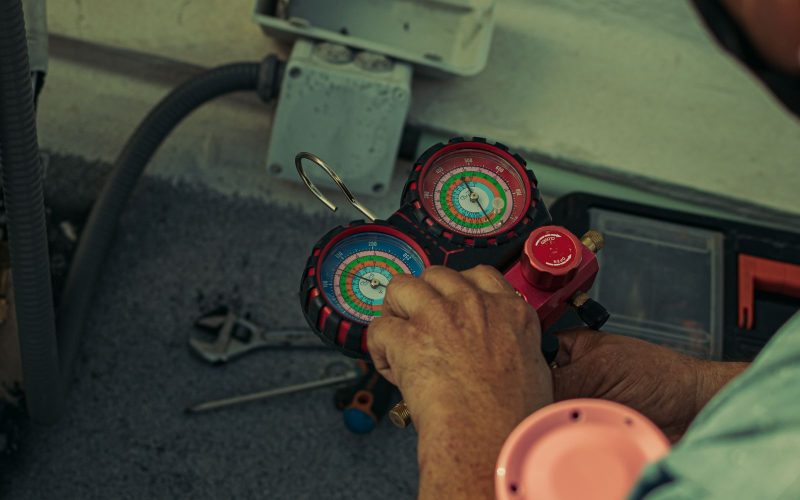
Alt text: “HVAC technician measuring static pressure on existing ductwork before a heat pump installation”
Why heat pumps are pickier about ducts
A gas furnace makes very hot air. A heat pump makes warm air. Both can heat your house just fine, but they do it differently, and that difference matters for ducts.
Think of it like filling a bathtub. A furnace fills it with a narrow stream of very hot water. A heat pump uses a wider stream of warm water. To deliver the same amount of heat with warmer-not-hot air, a heat pump needs to move more of it. More air needs enough room in the ducts, especially the return side, where air comes back to the system.
That’s why you’ll sometimes feel a heat pump’s air at a register and think “that’s not very hot.” It isn’t supposed to be. Heat pump supply air is typically noticeably cooler than a furnace’s, even when the system is doing its job perfectly. The house still warms up, just more steadily and with longer run times.
There’s a second difference. Heat pumps also cool, and cooling has always needed more airflow than furnace heating. A common rule of thumb is roughly 400 cubic feet per minute (CFM) of airflow for each ton of cooling capacity. If your home already has central air conditioning, your ducts were, at least in theory, designed around that airflow. That’s a big head start.
If you’re swapping a working central air conditioner for a heat pump of the same tonnage, the airflow the ducts need to carry doesn’t change much. That’s usually the easiest duct situation of all. Trouble starts when the heat pump is sized bigger than the old AC to cover winter heating, because now the ducts have to carry more air than they were built for.
The good news: your old furnace was probably too big
Here’s something that surprises a lot of homeowners. The furnace you have now is quite likely much bigger than your house needs.
For decades, furnaces were often sized with rules of thumb and a generous “just in case” margin. Energy Vanguard, a building-science consultancy, has written about a home with a 66,000 BTU/h furnace where a proper load calculation showed the house needed about 23,000 BTU/h. That’s roughly three times too big.
Why does that matter for ducts? Because when you replace an oversized furnace with a heat pump sized to the house’s real needs, the airflow the ducts must carry can be much lower than you’d fear. Ducts that looked too small for a big heat pump may be perfectly fine for a right-sized one.
That’s why the very first step isn’t a duct inspection. It’s a room-by-room load calculation, known as Manual J, that tells you how much heating and cooling your home actually needs. Our heat pump sizing guide explains what a proper calculation involves and why bigger isn’t better.
If a contractor sizes the heat pump by reading the old furnace’s nameplate, you’re likely to get an oversized system, and a duct recommendation built on the wrong number.
Size the heat pump to the house first. Then ask whether the ducts can carry it. Doing it the other way round is how people end up buying ductwork they didn’t need.
— The order that saves the most money
The three measurements that settle it
You don’t need to understand duct design to ask for these. You just need to know they exist and that a good contractor can take them.
1. Total external static pressure. This is the big one. It measures how hard the blower has to push to move air through your filter, coil and ducts. It’s measured in inches of water column with a small gauge called a manometer. Every air handler is designed to work up to a certain static pressure, and many residential units are rated around half an inch. If your system is well above what the equipment is designed for, airflow drops, noise rises and efficiency suffers. It takes a technician about ten minutes with the right tool.
2. Duct leakage. ENERGY STAR estimates that in a typical house, about 20 to 30 percent of the air moving through the duct system is lost to leaks, holes and poorly connected ducts. Leaks in an attic, crawlspace or garage mean you’re paying to heat or cool the outdoors. A duct leakage test pressurizes the ducts and measures how much air escapes. Some programs and contractors will also do a whole-house blower door test at the same visit.
3. Room-by-room airflow. A contractor can measure how much air comes out of each supply register and compare it to what each room needs according to the load calculation. That shows you which rooms are starved and which are over-served, which is often more useful than a single system-wide number.
If a contractor recommends duct changes, ask for the static pressure reading and the leakage result. A contractor who has measured will happily share them. If they haven’t measured, the recommendation is a guess, and you can ask them to test before quoting.
The duct problems that actually matter
Not every imperfect duct needs replacing. These are the issues most likely to cause trouble with a heat pump.
Undersized returns. This is the most common problem. Many homes have one small central return grille trying to feed a system that needs much more air. Signs include a loud whooshing at the return, a filter that gets sucked into its slot, and doors that slam or whistle when the system starts. Building-science writers regularly point to undersized returns as the main culprit behind high static pressure.
Leaky connections. Gaps at the joints, disconnected runs in the attic and crushed flex duct all waste air. Heat pump air is cooler than furnace air, so every bit of lost air is felt more.
Ducts in unconditioned space without enough insulation. Ducts running through a freezing attic or crawlspace lose heat on the way to your rooms. With warmer-not-hot heat pump air, those losses can make the far rooms feel chilly.
Long, kinked or sagging flex duct. Flex duct that’s stretched too long, crushed or sagging between supports adds a lot of resistance. Pulling it tight and shortening runs is one of the cheapest ways to improve airflow.
Closed or blocked registers. Closing vents in unused rooms doesn’t save money with a heat pump. It raises static pressure and reduces total airflow, which can hurt efficiency and comfort everywhere else.
With the system running, listen at the return grille. A loud rush of air, a filter that bows or gets sucked into its slot, or doors that pull shut when the blower starts are all common signs the return side is too small. They’re clues, not measurements, so mention them to your contractor.
Fixes, from cheapest to most involved
Duct work doesn’t have to be all-or-nothing. Most homes need a couple of targeted fixes, not a full replacement.
Open registers and clear returns
Free. Open every supply register, move furniture off returns and make sure the filter isn’t restrictive for your system.
Seal the leaks
ENERGY STAR recommends duct mastic or foil-backed tape, not ordinary cloth duct tape, which doesn’t hold up. Focus on ducts in attics, crawlspaces and garages first.
Straighten and shorten flex duct
Remove kinks, pull slack out and support sagging runs properly. It’s often a small job with a noticeable payoff.
Insulate ducts in unconditioned spaces
Keeps the air warm on its way to the rooms, which matters more with heat pump supply temperatures.
Add or enlarge return air
Adding a second return, or enlarging the existing one, is the classic fix for high static pressure. It can make a dramatic difference.
Modify specific runs
Enlarge a trunk or a few branch ducts serving rooms the load calculation shows are short on air.
Replace the system
The last resort, when ducts are badly deteriorated, dangerously leaky, or fundamentally too small even for a right-sized system.
If a gas furnace or water heater shares the space, duct sealing must never block its combustion air supply or touch its flue pipe. Anything near a flue is a job for a professional.
Alt text: “Sealing a leaky duct joint with mastic before installing a heat pump”
Reuse, modify or replace: a decision table
Costs vary so much by house that we’ve used relative cost rather than dollar figures. Your contractor’s measurements and quote are the numbers that count.
| What the tests show | Likely recommendation | Relative cost |
|---|---|---|
| Static pressure within the equipment’s range, modest leakage | Reuse as-is; seal accessible leaks | $ |
| High static pressure, returns clearly undersized | Add or enlarge returns | $$ |
| Heavy leakage in attic or crawlspace | Seal and insulate ducts in unconditioned space | $–$$ |
| A few rooms starved of air | Modify specific branch ducts or add a supply | $$ |
| Crushed, disconnected or deteriorated ducts throughout | Partial or full replacement | $$$ |
| Ducts fine but some rooms never comfortable (additions, bonus rooms) | Keep ducts; add a ductless head for the problem room | $$ |
That last row is worth highlighting. If one room over the garage or a converted attic has never been comfortable, the answer might not be a duct at all. A small ductless mini-split just for that room can be simpler than rerouting ductwork. Our ducted vs. ductless guide covers the trade-offs.
Plenty of homes run a ducted heat pump for most rooms plus one ductless head for a hard-to-reach space. It’s a common, sensible design, not a compromise.
How to read duct advice in a quote
Duct recommendations are one of the biggest sources of price differences between heat pump quotes. Here’s how to tell a solid recommendation from a sales pitch.
| Green flag | Red flag |
|---|---|
| “We measured static pressure at 0.8 inches; your returns are undersized” | “All old ducts need replacing with a heat pump” |
| Load calculation done before recommending duct changes | Heat pump sized to match the old furnace’s output |
| Specific fixes named, like “add a 20×25 return in the hallway” | “Upgrade ductwork” as a single vague line item |
| Offers to re-test static pressure after installation | No measurements before or after |
| Explains which rooms are short on air and why | Can’t say which rooms will improve |
Our guide to heat pump installation walks through the whole process from quote to commissioning, including what a proper handover should include.
If one contractor calls for full replacement and another doesn’t, ask each for their static pressure reading and what they found in the attic or crawlspace. The measurements usually settle it quickly.
6 mistakes with ducts and heat pumps
❌ Mistake 1: Sizing the heat pump to the old furnace
If the old furnace was two or three times too big, matching it gives you an oversized heat pump that needs more airflow than your ducts can carry.
❌ Mistake 2: Replacing ducts without measuring
New ductwork is expensive and disruptive. Without a static pressure and leakage test, nobody actually knows it’s needed.
❌ Mistake 3: Sealing ducts with cloth duct tape
Despite the name, ordinary duct tape dries out and fails on ducts.
❌ Mistake 4: Closing vents to “save energy”
Closing registers raises static pressure and cuts airflow for the whole system.
❌ Mistake 5: Ignoring the return side
People focus on supply vents because that’s where they feel the air. Most airflow problems start on the return side.
❌ Mistake 6: Judging the system by how hot the air feels
Heat pump air feels cooler than furnace air, and people assume something’s wrong.
Frequently asked questions
Can I use my existing ductwork for a heat pump?
Usually yes, if the heat pump is sized from a real load calculation and the ducts pass a static pressure and leakage check. Many homes need only sealing, a larger return or a few targeted fixes. Full replacement is only needed when ducts are badly damaged or too small even for a right-sized system.
Do heat pumps need bigger ducts than furnaces?
They need more airflow for the same amount of heat, because their air is warmer rather than hot. But most furnaces were oversized, and a right-sized heat pump often needs no more airflow than the existing ducts can handle, especially if the home already has central air.
What is static pressure and why does it matter?
Static pressure measures how hard the blower works to push air through the filter, coil and ducts. If it’s too high, airflow drops, the system gets noisier and less efficient, and components wear faster. It’s a quick test with a manometer, and it’s the single most useful measurement for deciding whether ducts need work.
Why does the air from my heat pump feel cool?
Heat pump supply air is warmer than room air but cooler than a furnace’s. That’s normal. The system makes up for it by moving more air and running longer. If the house holds your set temperature, the system is doing its job.
Should I seal my ducts before getting a heat pump?
Sealing leaky ducts in unconditioned spaces is almost always worthwhile, and doing it before the load calculation can let you buy a smaller heat pump. ENERGY STAR estimates typical homes lose 20 to 30 percent of duct air to leaks.
What if I have no ducts at all?
Then you don’t need to add them. Ductless mini-splits are designed for homes without ducts, and they’re often cheaper and less disruptive than installing a new duct system.
Your final checklist
✅ Your ductwork checklist
- Get a Manual J load calculation first — size the heat pump to the house, not the old furnace
- Ask for a static pressure reading — in writing, with the equipment’s rated limit
- Ask about duct leakage — a test, or at least an inspection of attic and crawlspace ducts
- Check the returns — loud whooshing, a sucked-in filter or slamming doors are clues
- Open every register — and clear furniture off return grilles
- Seal with mastic or foil tape — not cloth duct tape
- Insulate ducts in unconditioned spaces — attic, crawlspace and garage
- Compare duct advice across quotes — look for measurements, not opinions
- Consider ductless for problem rooms — additions and bonus rooms
- Ask for a post-install static pressure test — to confirm the fix worked
Budgeting the whole project? Our heat pump cost guide shows what installed systems typically cost, and our heat pump vs. furnace comparison covers the running-cost side. Tightening up the house first? See our guide to air sealing and insulation before a heat pump.
Sources

Heat Pump Reviews Editorial Team
Our editors research heat pumps full time: manufacturer specifications, AHRI and ENERGY STAR listings, published cold-climate performance data, warranty terms, installer feedback and owner reviews. We do not accept payment for placement, and every rating follows our published methodology.