How Heat Pumps Work: The Refrigeration Cycle, Reversing Valves, and Why Efficiency Beats 100%
A heat pump moves heat instead of making it. Here is how the refrigeration cycle, reversing valve, and inverter compressor turn one unit of electricity into two to four units of heat.


A heat pump does not make heat; it moves it. Using the same refrigeration cycle as your refrigerator, it pulls heat out of outdoor air (or the ground) and carries it indoors in winter, then runs in reverse to cool your home in summer. Because moving heat takes far less energy than creating it, a good heat pump delivers two to four units of heat for every unit of electricity it uses.
The refrigeration cycle in plain English
Every heat pump contains a closed loop of refrigerant, a chemical chosen because it boils at very low temperatures. Boiling and condensing are the whole trick: when a liquid boils it absorbs a large amount of heat, and when a vapor condenses it releases that heat again. The heat pump simply arranges for the boiling to happen where you want to remove heat and the condensing to happen where you want to deliver it.
Four parts do the work:
- Evaporator coil. Cold, low-pressure liquid refrigerant flows through a finned coil. Because the refrigerant is colder than the air blowing across the coil, it absorbs heat and boils into a vapor. In heating mode this coil is outdoors, and it works even in freezing air because the refrigerant is colder still.
- Compressor. The vapor is squeezed to high pressure. Compressing a gas raises its temperature, so the refrigerant leaves the compressor hot, typically well above 100°F. This is the only part of the cycle that uses meaningful electricity.
- Condenser coil. The hot vapor flows through a second coil where a fan blows indoor air across it. The refrigerant gives up its heat to the air and condenses back into a liquid.
- Expansion valve. The warm liquid passes through a restriction that drops its pressure sharply. Low pressure means a low boiling point, so the refrigerant becomes cold again and the loop starts over.
Your refrigerator does exactly this, pulling heat out of the food compartment and dumping it into your kitchen through the coils on the back. A heat pump treats the outdoors as the food compartment in winter and your living room as the condenser side.
The reversing valve: one machine, two directions
An air conditioner runs the cycle in one direction only: the indoor coil evaporates, the outdoor coil condenses. A heat pump adds a reversing valve, a four-port valve that swaps which coil receives the hot compressor discharge. Flip the valve and the outdoor coil becomes the evaporator (absorbing heat from outside air) while the indoor coil becomes the condenser (releasing heat into your ducts or a wall-mounted head).
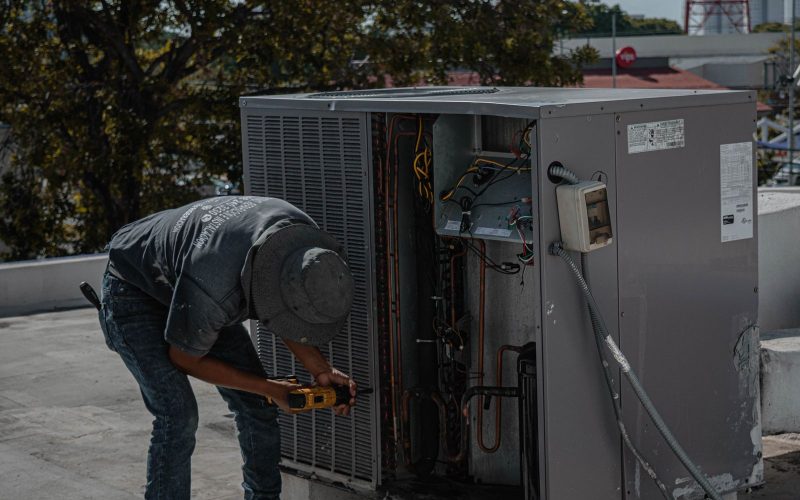
This is why the physical hardware of a heat pump looks identical to a central air conditioner. The difference is a valve, a slightly different control board, and some extra sensors. It is also why the choice between the two comes down to whether you want the heating side; our heat pump vs air conditioner comparison walks through that decision.
Why the COP is greater than 1
Coefficient of performance (COP) is heat delivered divided by electricity consumed. An electric resistance baseboard has a COP of exactly 1: every watt in becomes one watt of heat. A heat pump routinely scores 2 to 4 because the electricity only powers the compressor and fans; the heat itself is harvested for free from the air outside.
Two rules govern how high the COP can go. First, the smaller the temperature gap between the heat source and your home, the easier the job. At 47°F outdoors a modern unit might reach a COP of roughly 3.5 to 4.5; at 5°F the same unit may drop to around 1.75 to 2.5 because it has to lift heat across a much bigger gap. Second, the equipment itself matters: compressor design, coil size, and controls all affect how close a unit gets to the theoretical limit.
The U.S. Department of Energy estimates that a properly sized air-source heat pump can cut the electricity used for heating by roughly half compared with electric resistance heat. Seasonal ratings such as HSPF2 fold the COP at many temperatures into one number; we explain how to read them in our guide to SEER2, HSPF2, and COP.
Inverter and variable-speed compressors
Older heat pumps used a single-speed compressor that was either fully on or fully off. That works, but it wastes energy on every start-up, produces uneven temperatures, and struggles in cold weather because the compressor cannot work any harder when it is already at 100%.
An inverter converts the incoming AC power to a variable-frequency supply that lets the compressor motor run anywhere from about 20% to well over 100% of its nominal speed. The payoff is threefold:
- Efficiency. The unit runs long, slow cycles matched to the actual load instead of blasting and stopping, which keeps the coils working in their most efficient range.
- Comfort and noise. Low-speed operation means gentle airflow, steadier room temperatures, and outdoor sound levels in the 50s of decibels rather than the 70s. See our heat pump noise guide for what those numbers mean.
- Cold-weather capacity. Inverter units can overspeed the compressor when it is very cold, which is how cold-climate models keep delivering most of their rated heat at 5°F. Our guide to the best heat pumps for cold climates focuses on this class of equipment.
Nearly every heat pump worth buying in 2026 is variable-speed or at least two-stage. Single-stage units still exist at the budget end; our best budget heat pumps roundup covers where they make sense.
Not sure which model fits your home? Start with our ranked picks for 2026.
Find the Best Heat Pump for Your HomeDefrost cycles: why your heat pump steams in winter
In heating mode the outdoor coil runs colder than the outside air. Whenever that air is humid and below roughly 40°F, moisture freezes onto the coil fins. A little frost is harmless; a thick layer blocks airflow and starves the coil of heat.
To clear it, the control board periodically flips the reversing valve for a few minutes, sending hot refrigerant to the outdoor coil. The outdoor fan stops, the ice melts, and you may see a cloud of steam or a puddle under the unit. Indoors, the air handler either pauses or briefly runs the backup heater so you do not feel a draft of cool air. Then the valve flips back and normal heating resumes.
Defrost cycles typically last a few minutes and may occur every 30 to 90 minutes in cold, damp weather. Steam, dripping water, and a short whooshing sound are all normal. Thick ice that never clears, or ice on the compressor itself, is not; that calls for a service visit. Our maintenance checklist lists what else to watch for.
Air-source vs ground-source vs heat-pump water heaters
The refrigeration loop is the same in every heat pump. What changes is where the evaporator collects heat and where the condenser delivers it.
| Type | Where heat is collected | Where heat is delivered | Typical seasonal heating COP | Typical installed price (2026, before incentives) |
|---|---|---|---|---|
| Air-source, ducted (central) | Outdoor air | Existing or new ductwork | Roughly 2.5–3.5 | $8,000–$20,000 |
| Air-source, ductless (mini-split) | Outdoor air | Wall, ceiling, or floor indoor units per zone | Roughly 2.5–4.0 | $4,000–$8,000 single zone; $12,000–$25,000 multi-zone |
| Ground-source (geothermal) | Soil or groundwater via buried loops | Ductwork or radiant floors | Roughly 3.0–5.0 | $20,000–$45,000 |
| Heat-pump water heater | Air in a basement, garage, or utility room | A hot-water storage tank | Roughly 3.0–4.0 (rated as UEF) | $2,500–$6,500 |
Air-source units are the default choice for most homes and come in ducted and ductless forms; our ducted vs ductless comparison weighs them. Ground-source systems trade a large upfront cost for a heat source that stays near 50°F year-round, which is why the DOE describes them as operating at 300% to 600% efficiency even on the coldest nights. A heat-pump water heater is a small air-source unit mounted on a tank; it cools and dehumidifies the room it sits in while making hot water at two to three times the efficiency of a standard electric tank. The Rheem ProTerra review is a good example of the category.
Where the physics runs out
Heat pumps are not magic. As outdoor temperatures fall, two things happen: the unit’s capacity drops and its COP falls. Every home has a balance point, the outdoor temperature at which the heat pump’s output exactly equals the house’s heat loss. Below that point, something has to help: electric resistance strips in the air handler, a gas furnace in a dual-fuel setup, or simply a larger cold-climate unit.
Modern cold-climate models push the balance point far lower than older equipment. To earn ENERGY STAR’s cold-climate designation, a unit must deliver at least 70% of its rated capacity at 5°F with a COP of at least 1.75, and the strongest models on the NEEP cold-climate list keep 100% of rated capacity at 5°F and continue running to -13°F or below. The Mitsubishi Hyper-Heating review covers the model that set that benchmark.
Sizing is what makes the balance point work in your favor, so read our heat pump sizing guide before accepting a quote. And note that as of 2025 new systems ship with A2L refrigerants (R-454B or R-32) instead of R-410A; the cycle is unchanged, but installation practices are not, as we cover in our report on the R-454B refrigerant transition.
Not sure which model fits your home? Start with our ranked picks for 2026.
See Our Top PickOur recommendation
If you take one idea from this article, make it this: a heat pump is a heat mover, and everything about its performance follows from how large a temperature gap it has to bridge. Choose a variable-speed unit, size it for your climate’s heating load rather than a rule of thumb, and make sure your installer understands the balance point for your house. Do that and the COP will take care of itself. To see which models make the most of the physics, start with our best heat pumps of 2026.
Frequently asked questions
Because it moves heat rather than generating it. The electricity powers a compressor and fans, while the heat itself is collected from outdoor air or the ground. Delivering 3 units of heat for 1 unit of electricity (a COP of 3) is normal for a modern unit in mild weather.
Yes. The refrigerant in the outdoor coil is far colder than freezing air, so it still absorbs heat. Capacity and efficiency fall as temperatures drop, which is why cold-climate models are designed to keep most of their rated output at 5°F and to run to -13°F or lower.
That is a defrost cycle. The unit briefly reverses to melt frost off the outdoor coil, which produces steam and a short pause in heating. Short cycles every 30 to 90 minutes in cold, damp weather are normal. Persistent thick ice is not.
Mechanically, a reversing valve. An air conditioner only moves heat from indoors to outdoors. A heat pump can flip the direction of refrigerant flow so the same equipment heats in winter and cools in summer.
For most homes, yes. Inverter compressors run long, slow cycles matched to the load, which improves efficiency, keeps temperatures steadier, lowers noise, and lets the unit boost output in cold weather. Single-stage units are cheaper but give up all four advantages.
Generally yes, because the ground stays near 50°F year-round while winter air can be far colder. The DOE describes geothermal systems as 300% to 600% efficient on the coldest nights. The trade-off is a much higher installed cost for the buried loop field.
Sources

Heat Pump Reviews Editorial Team
Our editors research heat pumps full time: manufacturer specifications, AHRI and ENERGY STAR listings, published cold-climate performance data, warranty terms, installer feedback and owner reviews. We do not accept payment for placement, and every rating follows our published methodology.