Pairing a Heat Pump With Solar Panels: Does It Actually Work?
A heat pump makes every solar kWh go two to four times further — but panels generate most in June and you heat in January. Whether that works comes down to your export rate.

Yes, but the seasons don’t line up
A heat pump turns one kWh into two to four kWh of heat, so solar electricity goes further than it does anywhere else in the house. The catch is timing: your panels produce most in June and your heating bill lands in January.
A heat pump and solar panels work well together, but almost never in the same month — the pairing depends entirely on how your utility credits the power you export in summer.
Under full-retail net metering, summer surplus banks against winter consumption and the combination is genuinely strong. Under net billing or avoided-cost export rates, which more states have shifted toward, exported kWh are worth far less than the kWh you buy back in January, and the maths gets much tighter. Find out which regime you are in before you size anything. 💡
The appeal is easy to understand and mostly real. A gas furnace burns a fuel you cannot make on your roof. A heat pump runs on electricity, and electricity is the one energy carrier a homeowner can produce. Put the two together and you have, in principle, a house that heats itself from sunlight.
In practice, the pairing has one structural problem that no amount of good equipment fixes: solar output peaks in summer and heating demand peaks in winter. In a northern state, December and January together might deliver less than a tenth of a year’s generation, on the shortest days, with the lowest sun angle, and sometimes under snow. Those are exactly the weeks your heat pump is working hardest.
Everything below is about how people bridge that gap — net metering, array sizing, batteries, load shifting, and the one appliance that pairs with solar better than the heat pump itself does.
What’s in this guide
- Why the pairing is appealing
- The seasonal mismatch, in numbers
- Net metering, net billing, and why it matters so much
- Sizing the array for a heat pump
- Batteries: what they do and don’t solve
- Time-of-use rates and pre-heating on solar hours
- Both at once, or one then the other?
- Heat pump water heaters: the better solar match
- 6 mistakes people make with this pairing
- Frequently asked questions
- Your checklist
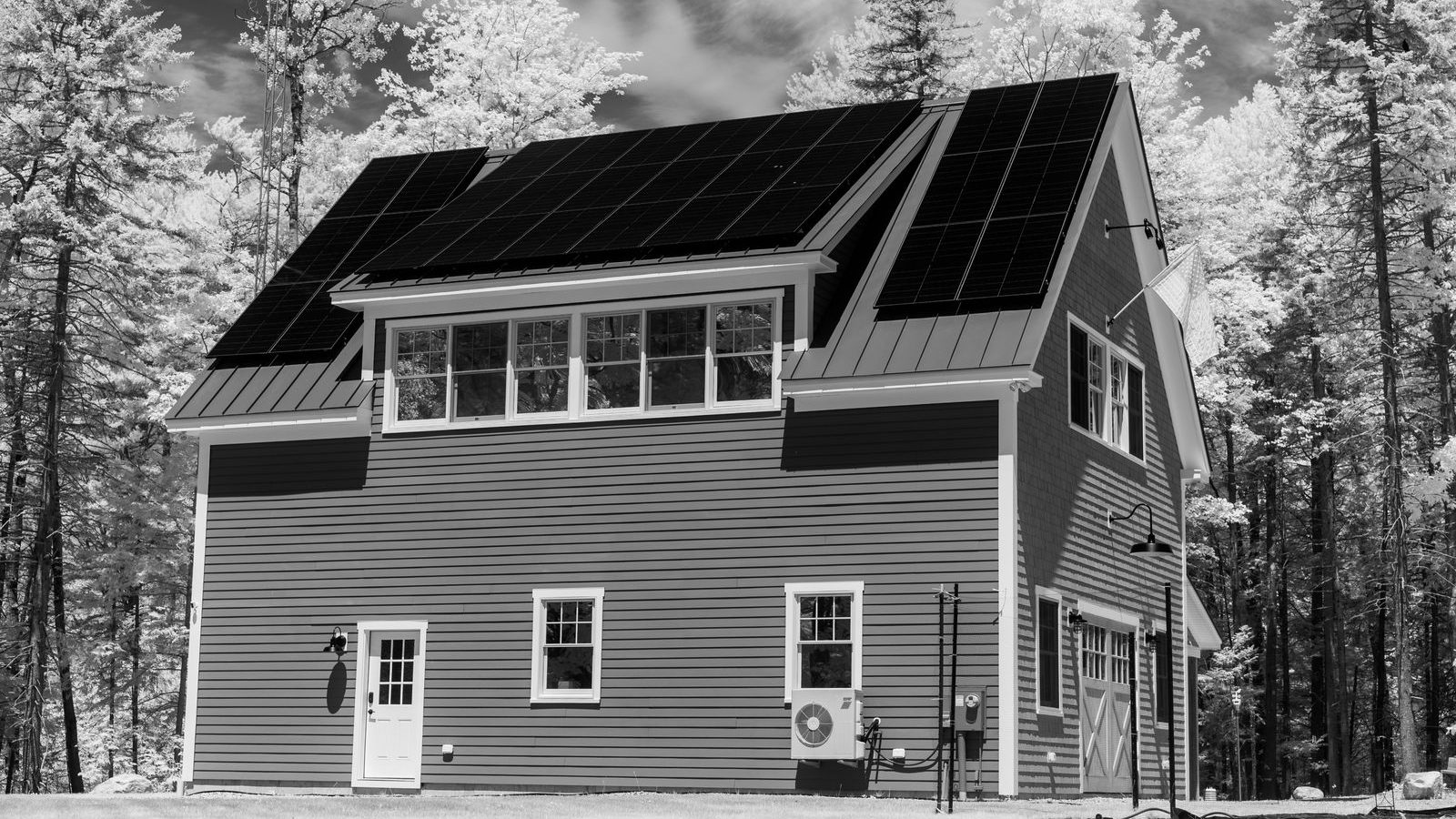
Alt text: “Home with rooftop solar panels and an outdoor heat pump unit in winter sunlight”
Why the pairing is appealing
Start with what makes it more than a marketing story. A solar panel produces electricity. Most appliances consume that electricity at face value: one kWh in, one kWh of work out. A heat pump does not. It uses electricity to move heat rather than create it, so one kWh of solar electricity typically becomes two to four kWh worth of heat inside the house, depending on the outdoor temperature. If you want the mechanism, our explainer on how heat pumps work covers it.
That multiplier is the whole argument. Solar electricity powering a resistance heater displaces heat at a one-to-one rate. The same solar electricity powering a heat pump displaces three times as much. It is the most leveraged use of a rooftop kWh available in a normal house.
There is a second, less obvious reason the two go together. A heat pump replaces a combustion appliance with an electric one, which means it converts a fuel bill you cannot influence into an electricity bill you can partly self-supply. Homeowners who install solar and then keep a gas furnace have solar covering lighting, laundry and air conditioning — real, but a modest slice. Add the heat pump and the solar array is offsetting the largest energy use in most cold-climate homes.
And a third: cooling. Air conditioning demand peaks on hot, sunny afternoons, which is exactly when a solar array is at full output. That part of the pairing lines up beautifully with no clever tricks required. It is only the heating half that fights the calendar.
Solar plus a heat pump is the best-leveraged pairing in the house — and the worst-timed one.
— the tension every honest analysis has to sit with
Both of the big federal residential credits have now closed. The 25C credit that covered heat pumps ended for property placed in service after 31 December 2025, and the 25D residential clean energy credit that covered rooftop solar ended for installations completed after the same date. State programs, utility rebates and HEAR-funded programs may still be available where you live, and third-party ownership arrangements are treated differently under the tax code. Check current status with a tax professional and see what’s left in 2026 and what the end of the federal credit changed.
The seasonal mismatch, in numbers
Abstract talk about “seasonal mismatch” does not land until you see it month by month. The table below is an illustration, not a prediction for your house: a 7 kW array on a home in a cold climate, roughly IECC zone 5, paired with a heat pump heating about 2,000 square feet. Solar output uses a typical northern production profile; heating consumption uses the seasonal pattern from our guide to heat pump running costs.
| Month | Solar output (kWh) | Heat pump heating use (kWh) | Surplus or shortfall |
|---|---|---|---|
| January | 260 | 1,940 | −1,680 |
| February | 420 | 1,620 | −1,200 |
| March | 700 | 1,050 | −350 |
| April | 890 | 490 | +400 |
| May | 1,010 | 0 | +1,010 |
| June | 1,060 | 0 | +1,060 |
| July | 1,060 | 0 | +1,060 |
| August | 970 | 0 | +970 |
| September | 790 | 0 | +790 |
| October | 610 | 400 | +210 |
| November | 350 | 970 | −620 |
| December | 220 | 1,620 | −1,400 |
| Year | ~8,340 | ~8,090 | Roughly balanced |
Illustration only. Heating load excludes cooling, hot water and everything else in the house — real summer surplus would be smaller once air conditioning is included. Solar output varies widely with latitude, roof pitch, orientation and shading; model your own with NREL’s PVWatts tool.
Look at the bottom row, then look at January. On an annual basis the array covers the heat pump almost exactly. In January it covers about 13% of it. That is the mismatch in one table, and it is why the pairing lives or dies on what happens to those summer surplus kWh.
Three things make winter output worse than people expect. Days are short, so there are simply fewer generating hours. The sun sits low, so light hits the panel at a poor angle. And snow that settles on a panel stops production entirely until it slides or melts off — usually a day or two after a storm on a decently pitched roof, longer on a shallow one. Panels do run more efficiently in cold air, which is a real effect, but it is nowhere near enough to offset the other three.
If you are picturing a house that heats itself from its own panels through a January cold snap with no grid connection, understand the scale: you would need to size for the worst week of the year, which typically means an array several times larger than an annual-offset system plus a very large battery bank. Almost every practical residential heat-pump-plus-solar setup in the US is grid-tied and uses the grid as its seasonal storage.
Net metering, net billing, and why it matters so much
This is the section that determines whether the pairing works for you, and it is entirely a policy question rather than a technical one.
Full-retail net metering is the arrangement that made the table above work. Every kWh you export earns a credit equal to a kWh you later import, at the retail rate. Your summer surplus banks up, sits on the account, and gets drawn down through the winter. Under that rule, an array sized to your annual consumption really does offset a heat pump, seasonal mismatch and all. The grid acts as a free, lossless seasonal battery.
Net billing — sometimes called a value-of-solar or successor tariff — breaks that symmetry. Exports are credited at a value the regulator sets, often based on the utility’s avoided cost and often varying by hour, while imports are still billed at the full retail rate. When the export credit is well below retail, a summer kWh no longer buys a winter kWh. It buys a fraction of one.
The national trend over the past several years has been away from full-retail net metering. Regulators in a substantial number of states have opened proceedings on it, and several have adopted successor tariffs. California’s net billing tariff, widely known as NEM 3.0 and approved by the state’s regulator in late 2022, is the most-discussed example: it moved new customers to hourly avoided-cost export values and, by most published accounts, cut typical export compensation dramatically compared with the previous rules. Arizona moved away from full-retail net metering some years earlier. Other states have kept retail-rate crediting, and some have locked in long grandfathering periods for existing customers.
Net metering rules change through regulatory proceedings that can conclude in months, and many states apply different rules to different utilities. Before you size an array around a heat pump, get the answer from two places: the DSIRE database (dsireusa.org, maintained at NC State) and your own utility’s current tariff sheet. Ask three specific questions — what rate are exports credited at, do credits roll over or expire, and when is the annual true-up? Any installer who cannot answer all three in writing is not the installer you want.
| Compensation model | How exports are credited | What it means for a heat pump |
|---|---|---|
| Full-retail net metering | 1 kWh exported offsets 1 kWh imported, at retail | Summer surplus banks against winter almost fully. The strongest case for the pairing. |
| Net billing / value of solar | Exports credited at a set or hourly value below retail | Banking still works but at a discount. Self-consumption and load shifting matter much more. |
| Avoided-cost export only | Wholesale-style rate, often a few cents per kWh | Seasonal banking barely works. Value comes from using your own generation as it is produced. |
| Any model, monthly true-up | Credits reset each month rather than rolling forward | Summer surplus can expire long before winter. This detail alone can undo the whole plan. |
General structures only. Specific terms vary by state and by utility — verify yours.
The true-up question deserves emphasis because it is the one people miss. A generous export rate with a monthly reset is worse for heat pump pairing than a mediocre export rate with a twelve-month rollover, because the whole strategy depends on carrying June credits into January. Ask about the rollover explicitly.
Sizing the array for a heat pump
The starting point is straightforward: work out how much extra electricity the heat pump will consume in a year, then work out how much array produces that much.
For the first half, use the formula from our running cost guide — annual heating load in BTU, divided by 3,412, divided by seasonal COP. If all you have is the unit’s HSPF2 rating, divide it by 3.412 for an approximate seasonal COP; our explainer on SEER2, HSPF2 and COP covers why the seasonal figure is the one to use. For the second half, a rule of thumb: 1 kW of installed solar produces roughly 1,100 to 1,800 kWh a year in the US, with the low end representing cloudy northern regions and poorly oriented roofs and the high end the sunny Southwest with a good south-facing pitch. Model your own roof in NREL’s free PVWatts calculator rather than guessing.
| Climate | Extra heat pump electricity per year | Roughly how much extra array |
|---|---|---|
| Mild (zones 2–3) | ~1,200 – 2,500 kWh | ~1 – 2 kW |
| Moderate (zone 4) | ~3,000 – 5,500 kWh | ~2 – 4.5 kW |
| Cold (zones 5–6) | ~5,500 – 9,000 kWh | ~4 – 8 kW |
| Very cold (zone 7) | ~8,000 – 13,000 kWh | ~6 – 11 kW |
Wide ranges, and deliberately so. Based on a roughly 2,000 sq ft home; scale up or down with size, insulation and seasonal COP. Assumes an average of about 1,200 to 1,500 kWh per kW per year — check your own location. In a home currently heated by electric resistance, a heat pump reduces existing consumption rather than adding to it, so no extra array is needed at all.
Three adjustments to that arithmetic, all of which push in the same direction.
First, your roof has a limit. In the cold-climate rows, the extra array a heat pump implies is a substantial addition on top of whatever covers the rest of the house — and a great many roofs simply do not have that much usable, unshaded, well-oriented area. That constraint decides the size for a lot of households before any economics come into it.
Second, under net billing, sizing to 100% of annual consumption over-builds. If exports earn well below retail, the last few kilowatts of array are producing power you mostly sell cheaply. Under those tariffs, installers commonly size closer to self-consumption than to annual offset. Under full-retail net metering, sizing to annual consumption still makes sense.
Third, reduce the load before you buy the array. Every dollar spent on air sealing and attic insulation shrinks the heating load permanently, which shrinks the array you need, which is almost always cheaper than adding panels. It also makes pre-heating strategies work better, which we come to below.
A heat pump, a solar inverter and possibly a battery all land on the same main panel. Plenty of homes with 100-amp service need an upgrade, a load calculation under the current NEC, or a smart panel or load-management device to avoid one. Find this out during the quote stage rather than on install day — see what to expect during installation.
Batteries: what they do and don’t solve
Batteries come up immediately in this conversation, and they are frequently oversold for the winter heating problem. It is worth being precise about what a home battery actually does.
What a battery does well. It shifts energy across hours. Solar generated at 1 p.m. can be used at 7 p.m. That is genuinely valuable under time-of-use rates and increasingly valuable under net billing, where exporting at midday earns little and importing in the evening costs a lot. It also provides backup power during an outage, which for a household that now heats electrically is not a small consideration.
What a battery does not do. It does not shift energy across seasons. A typical home battery holds something in the range of 10 to 20 kWh of usable capacity. Look back at the January row in the table above: that house needed roughly 1,940 kWh of heating electricity that month, about 63 kWh a day. A 13.5 kWh battery covers a fraction of a single cold day, and in January there is barely any surplus solar to charge it with in the first place. Storing June sunshine until December is not something residential batteries do, and no consumer product on the market changes that.
If your goal is keeping the heat on during an outage, size for that explicitly and talk to your installer about it. A whole-house heat pump plus auxiliary resistance strips is a heavy electrical load, and many battery-plus-inverter combinations cannot start or sustain it without load management. Some households deliberately keep a single ductless head or a non-electric backup heat source for exactly this reason.
There is a case where batteries genuinely improve the heat pump pairing, and it is a specific one: a net billing tariff with a wide time-of-use spread. There, the battery captures midday generation that would have earned a low export credit and releases it during the expensive evening peak when the heat pump is running hard. That is real arbitrage with real value. It is an hours-scale story, not a seasons-scale one, and it should be evaluated on its own numbers rather than folded into the solar decision.
Time-of-use rates and pre-heating on solar hours
If you have solar, you are often on a time-of-use rate — some tariffs require it — and that changes how you should run the heat pump.
The idea is straightforward. Your array produces most between roughly 10 a.m. and 3 p.m. Under many TOU plans that window is also cheap grid power, and the expensive block starts in the late afternoon and runs into the evening. So you want the heat pump doing as much work as possible while the sun is up, and as little as possible during the peak.
The tool for this is pre-heating: raise the setpoint a degree or two during the solar window, let the building’s thermal mass absorb it, then drop back to normal before the peak begins and coast. Floors, drywall, furniture and any masonry all hold heat for hours, and the tighter and better-insulated the house, the longer the coast lasts.
One to two degrees up during solar hours is fine. Do not turn this into a large setback during the peak — if the house falls several degrees and then has to recover fast, the thermostat brings on auxiliary electric resistance heat, which has a COP of 1.0 and will cost you far more than the peak rate ever would. Our guides to thermostat settings and emergency versus auxiliary heat explain the trigger logic.
A few practical points. Most smart thermostats can run this on a schedule, and some integrate with utility rate plans or solar monitoring. Variable-speed inverter equipment suits the strategy better than single-stage, because it can run gently at part load through the whole solar window instead of cycling on and off. And a well-sealed home holds a pre-heat far better than a leaky one — another reason the envelope work comes first.
The same logic applies to everything else with flexible timing: laundry, dishwasher, EV charging and, best of all, the water heater. Shifting those into the solar window raises the share of your own generation you actually consume, which is the metric that matters most under net billing.
Both at once, or one then the other?
There is no single right answer, but there is a decent default: size the array around the electrified house you intend to end up with, even if you install in stages.
Doing both at once has real advantages. You only deal with one round of permitting, one set of electrical service questions and one main panel decision. If your service needs upgrading, that cost gets absorbed once rather than twice. And you avoid the common trap of installing solar sized to a gas-heated house, then electrifying two years later and discovering the array covers a fraction of the new load.
Staging has advantages too, and the strongest is cash flow. These are both substantial purchases — our 2026 installed cost guide and the cost calculator cover the heat pump half — and doing them separately spreads the outlay. See heat pump financing options for how people structure that. Staging also lets you gather real data: a year of running the heat pump gives you actual metered consumption to size the array against, rather than an estimate.
Two reasons. It gives you a real consumption number to size the array against instead of a projection. And if your current heating system is oil, propane or electric resistance, the heat pump typically cuts running cost from day one regardless of what the roof is doing. Check first whether your home is a good candidate at all — our guide on whether a heat pump suits your home covers the screening questions.
Two things worth doing at the solar stage even if the heat pump comes later. Have the electrician document what capacity the panel has left and what an upgrade would cost. And do not let anyone talk you into an array sized to today’s gas-heated bill if electrification is on your five-year plan — under most tariffs it is cheaper to add capacity at the original install than to come back for a second, smaller job.
Heat pump water heaters: the better solar match
Here is the part that gets left out of most articles on this subject. If you want an appliance that pairs beautifully with rooftop solar, the strongest candidate in the house is not the space heating system. It is the water heater.
A heat pump water heater has the same efficiency advantage — it moves heat rather than making it, typically delivering two to four times the energy it consumes — but it has one thing the space heating system does not: a large insulated tank, which is thermal storage you already paid for. Heat water at noon on solar power and it is still hot at 8 p.m. No battery required.
That makes it close to an ideal self-consumption load. Set the water heater’s schedule so its main heating cycle falls inside the solar window, and a large share of the electricity it uses is your own generation rather than imported power. Most current models have a scheduling or vacation function that makes this easy, and some support utility demand-response programs that pay you for the same behavior.
The demand is also far steadier than space heating. Hot water use varies modestly through the year, so unlike your heat pump, the water heater is a load your array can meaningfully cover in every month including January. ENERGY STAR figures put a heat pump water heater’s annual consumption in the region of 900 kWh for a typical household, which is a small enough number that even a modest array covers it comfortably.
A heat pump water heater pulls heat from the air around it, so it needs adequate space and air volume — manufacturers typically specify a minimum room size or a ducting arrangement — and it cools and dehumidifies that space as it runs, which is welcome in a basement in summer and less so in a conditioned closet in winter. It also runs on a longer, quieter cycle than a gas unit, so recovery after a long shower takes more time. Our hybrid water heater review walks through what those constraints look like in practice.
Alt text: “Heat pump water heater in a basement utility room, showing the top-mounted heat pump module”
6 mistakes people make with this pairing
❌ Mistake 1: Assuming net metering works the way it did five years ago
Export compensation rules have shifted in a lot of places, and the direction of travel has generally been toward lower export credits. Sizing an array on the assumption of full-retail banking, in a state that has moved to net billing, produces a system that under-delivers from the first bill.
❌ Mistake 2: Expecting a battery to carry winter heating
A 10 to 20 kWh home battery is a few hours of a cold-climate heat pump’s January consumption, and there is very little surplus solar in January to charge it anyway. Batteries shift hours, not seasons.
❌ Mistake 3: Sizing the array to a gas-heated house, then electrifying later
An array covering a house with a gas furnace can be less than half of what the same house needs once heating moves onto electricity. Coming back to add panels later usually costs more per watt than including them at the start.
❌ Mistake 4: Ignoring the true-up date
A tariff that resets credits monthly cannot carry June surplus into January, no matter how favorable the export rate looks. This detail quietly undoes the entire seasonal-banking strategy and it is rarely front and center in a sales conversation.
❌ Mistake 5: Buying panels before fixing the envelope
Generating electricity to push through an uninsulated attic is expensive in a way that insulation is not. A leaky house needs a bigger heat pump, a bigger array and more of both running in January.
❌ Mistake 6: Believing a payback figure quoted in a sales meeting
Payback for solar plus a heat pump depends on your export rate, your rate plan, future utility price changes, your climate, your roof and your installed price. Several of those are unknowable. A confident single number is a sales tool, not an analysis.
Frequently asked questions
Can solar panels power a heat pump through winter?
Not month by month in most of the country. In a northern climate, December and January generation can be a small fraction of the annual total while heating demand is at its highest, so the array covers only part of the heat pump’s winter consumption. What makes the pairing work is annual accounting: summer surplus is exported and credited, then drawn back down in winter. That only works well where the utility credits exports generously and lets credits roll over.
How many extra solar panels does a heat pump need?
As a rough guide, a mild-climate home might add 1 to 2 kW of array, a moderate climate 2 to 4.5 kW, and a cold climate 4 to 8 kW or more, on a home of about 2,000 square feet. Those are wide ranges because seasonal COP, insulation and local solar resource all move the answer. Work out the heat pump’s annual kWh first, then divide by roughly 1,100 to 1,800 kWh per kW per year depending on your location.
Does snow on the panels stop them working?
Yes, while it is there. A snow-covered panel produces essentially nothing until the snow slides off or melts, which on a reasonably pitched roof usually takes a day or two after a storm and longer on a shallow pitch. Clearing panels from the ground is possible with the right tool but climbing onto a snowy roof to do it is not worth the risk. Most annual production models already assume some winter snow losses.
Is a battery worth it if I have a heat pump?
It depends on why you want one. For backup power during outages in a home that now heats electrically, it can be worth a lot, though sizing for a heat pump load takes care. For shifting midday solar into an expensive evening peak under a time-of-use or net billing tariff, the economics can work. For covering winter heating from stored summer solar, no — home batteries hold hours of heating, not months.
Should I install solar and a heat pump at the same time?
Together is often simpler: one permitting process, one electrical service decision, and an array sized to the electrified house from the start. Staging is fine for cash flow, and installing the heat pump first has the advantage of giving you real metered consumption to size the array against. Either way, tell the solar installer about the heat pump plan so the array is not sized to a gas-heated house you are about to stop having.
What is the difference between net metering and net billing?
Under full-retail net metering, a kWh you export offsets a kWh you later import at the retail rate, so the grid works like a bank. Under net billing, exports are credited at a lower value — often the utility’s avoided cost, sometimes varying by hour — while imports are still charged at retail. The gap between those two numbers is what decides how well summer solar covers winter heating. Confirm which applies to your utility before you size anything.
Is a heat pump water heater a better solar pairing than a heat pump?
For self-consumption, often yes. The tank is thermal storage you already own, so you can heat water during the solar window and use it hours later without a battery. Demand is also fairly steady year-round rather than concentrated in winter, and typical annual consumption is modest — ENERGY STAR figures put it in the region of 900 kWh for a household. It will not replace space heating, but it is one of the easiest loads to shift onto your own generation.
Your checklist
✅ Your checklist
- Find out your export rules first — retail net metering, net billing or avoided cost changes everything downstream
- Ask about the true-up — monthly credit expiry defeats seasonal banking on its own
- Verify at DSIRE and on your utility’s tariff sheet — not from a sales deck or a state-by-state blog table
- Work out the heat pump’s annual kWh — heating load ÷ 3,412 ÷ seasonal COP
- Model your roof in PVWatts — 1 kW yields roughly 1,100–1,800 kWh a year depending on where you are
- Air-seal and insulate before sizing anything — a smaller load means a smaller array and a smaller unit
- Check the electrical service early — heat pump, inverter and battery all land on the same panel
- Treat batteries as an hours tool, not a seasons tool — buy them for backup or peak shifting
- Pre-heat 1–2°F during solar hours — and never let it become a deep setback that triggers resistance heat
- Add a heat pump water heater to the plan — the tank is free thermal storage for midday sun
- Ignore any single payback number — ask for the assumptions and run the pessimistic case yourself
Sources
- NREL — PVWatts Calculator (solar production modeling)
- DSIRE — Database of State Incentives for Renewables & Efficiency (NC Clean Energy Technology Center)
- IRS — FAQs on modification of sections 25C, 25D and others under Public Law 119-21
- ENERGY STAR — Heat Pump Water Heaters
- NARUC — Review of State Net Energy Metering and Successor Rate Designs

Heat Pump Reviews Editorial Team
Our editors research heat pumps full time: manufacturer specifications, AHRI and ENERGY STAR listings, published cold-climate performance data, warranty terms, installer feedback and owner reviews. We do not accept payment for placement, and every rating follows our published methodology.