The Best Thermostat Settings for a Heat Pump (and the Habit Costing You Money)
With a furnace, deep setbacks save money. With a heat pump they can cost you, because recovery pulls in expensive backup heat. Here are the settings that actually work, season by season.

Set it and mostly forget it
A heat pump likes a steady thermostat. The deep nightly setback that saves money with a gas furnace can cost you money with a heat pump, because climbing back up pulls in expensive backup resistance heat.
Pick one comfortable winter temperature, leave it there, and if you do set back at night, keep it small — two to four degrees.
The Department of Energy puts it plainly: with a heat pump in heating mode, setting back the thermostat can make the system run inefficiently and cancel out the savings you were chasing. In summer, a heat pump is just an air conditioner, so normal setback rules come back. 💡
Almost everything you have read about thermostats was written with a furnace in mind.
A furnace has one speed: full blast. It does not care whether it is warming your house by two degrees or ten. So dropping the thermostat overnight is free money — the furnace simply runs a bit longer in the morning at the same efficiency it always runs at.
A heat pump does not work that way. It moves heat instead of making it, and it moves that heat gradually. Ask it for a big temperature jump in a hurry and it cannot deliver. So the thermostat calls in the backup: electric resistance strips, which are roughly three times more expensive per unit of heat. You saved a little overnight and then handed it all back between 6 and 8 in the morning.
That is the habit costing people money. Below is what to do instead — winter and summer setpoints, when a modest setback is still fine, what smart recovery actually does, why the fan should be on AUTO, and where the thermostat itself should live on your wall.
What’s in this guide
- Why heat pumps break the setback rule
- Winter settings: where to land
- When a small setback still makes sense
- Smart recovery and adaptive recovery
- Summer settings, humidity and dry mode
- Fan on AUTO or ON?
- Why cranking it to 80°F does nothing
- Scheduling around time-of-use rates
- Where the thermostat should live
- Do this, not that
- 6 mistakes we see constantly
- Frequently asked questions
- Your settings checklist
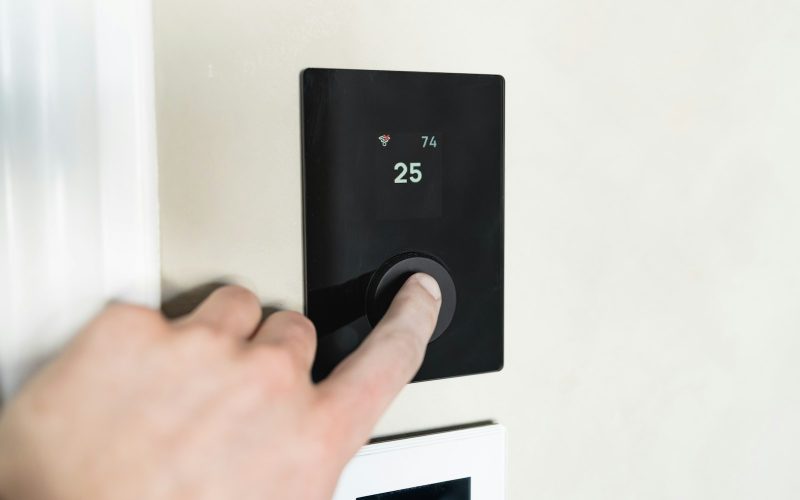
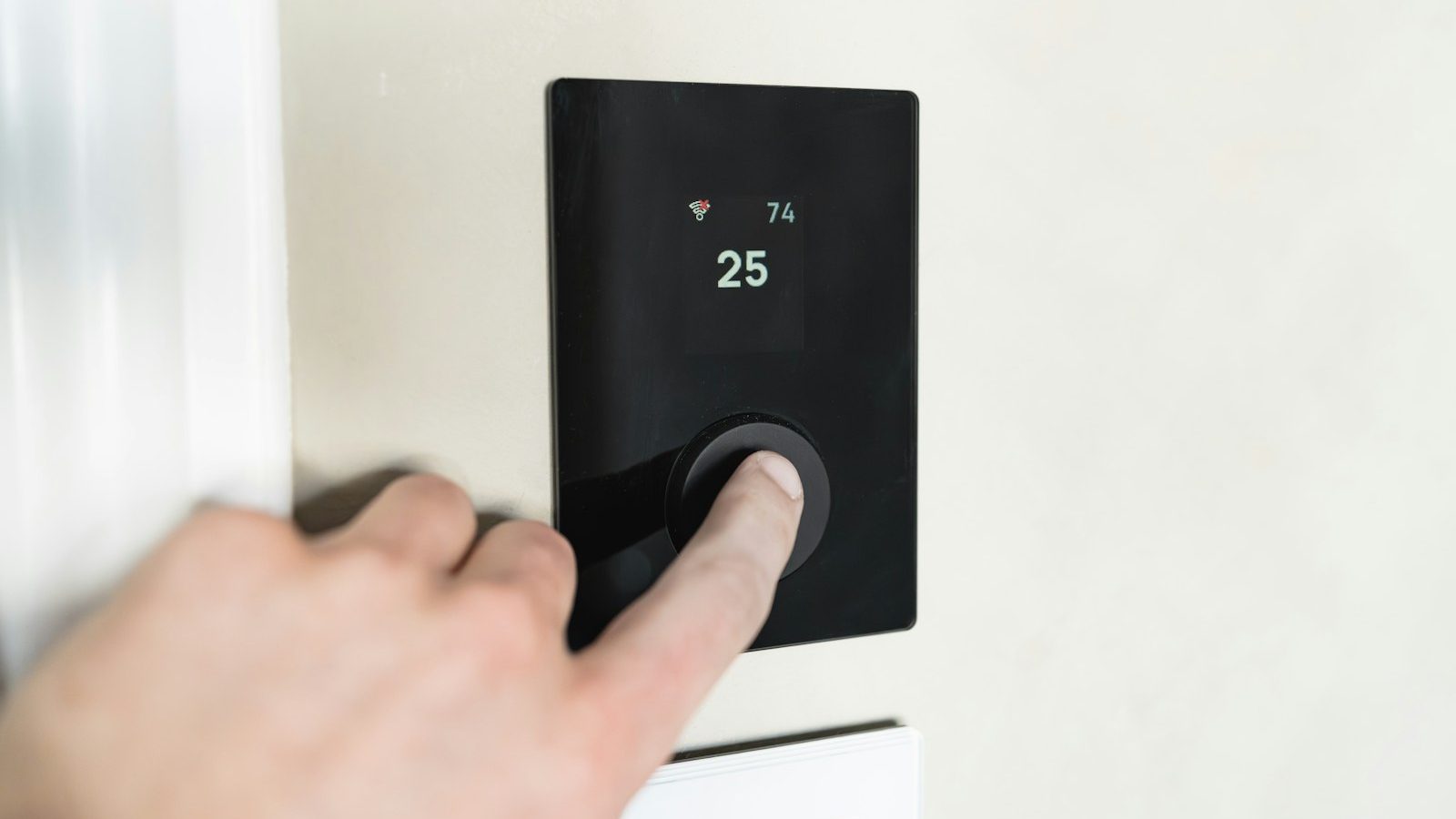
Alt text: “Smart thermostat set to 68 degrees in heat pump heating mode on an interior hallway wall”
Why heat pumps break the setback rule
Here is the mechanical reason, in plain terms. A furnace burns fuel and produces a fixed, large amount of heat whenever it fires. A heat pump collects heat from outdoor air and carries it inside, and the amount it can carry depends on how cold it is outside. On a 45°F morning it has plenty of spare capacity. On a 20°F morning it is already working near its limit just to hold the house steady.
Now imagine you dropped the house to 62°F overnight and want 70°F by 7 a.m. The thermostat sees an eight-degree gap. Most heat pump thermostats have a rule built in: if the indoor temperature is more than about two degrees below setpoint, or if the system has been running for a set stretch without closing the gap, bring on the auxiliary heat. Those resistance strips are typically 5 to 20 kilowatts of pure electric heat. They will absolutely close the gap. They will also cost roughly three times what the heat pump costs to deliver the same warmth, which is exactly the point of our companion guide on emergency heat versus auxiliary heat.
The Department of Energy’s Energy Saver guidance says it directly: do not set back a heat pump’s thermostat if doing so brings on the backup heating, because setting back a heat pump in heating mode can make it operate inefficiently and cancel out the savings. That is not marketing copy from a thermostat company. It is the federal energy agency telling homeowners the furnace rule does not transfer.
There is a second, quieter reason steady beats swingy. Modern variable-speed and inverter heat pumps are most efficient when they run long and slow at low compressor speed. Long, gentle runs at 40% capacity use less energy per unit of heat than short bursts at 100%. A big setback forces exactly the wrong behavior: the system sits idle, then sprints. If you want to understand why part-load operation is where the efficiency lives, our explainer on SEER2, HSPF2 and COP walks through it.
With a furnace, you save by turning it off. With a heat pump, you save by letting it run.
— the single sentence that fixes most heat pump bills
In summer a heat pump runs in reverse and behaves like a standard air conditioner. There is no resistance backup involved in cooling, so ordinary setback advice works fine. The “leave it alone” rule is a winter rule.
Winter settings: where to land
ENERGY STAR’s long-standing winter reference point is 68°F while you are home and awake. That is a reasonable place to start, not a commandment. Some people are comfortable at 66°F in a sweater. Some households have an infant, an elderly parent or someone with a circulation condition and genuinely need 72°F. Comfort is not a moral failing, and a thermostat setting that makes your home unpleasant is a setting you will abandon by February.
What matters more than the exact number is that you pick one and hold it. Every degree you add costs something — a common rule of thumb from utility programs is roughly 1% to 3% more heating energy per degree, and the real figure depends on your climate, insulation and equipment. But that penalty is predictable and small. The penalty from repeatedly triggering resistance heat is neither.
| Season / period | Reasonable range | Why |
|---|---|---|
| Winter, home and awake | 66–70°F (68°F common) | Comfortable for most people; keeps the heat pump running steadily at low compressor speed where it is most efficient. |
| Winter, asleep or away (mild climate, above ~35°F outside) | Setback 3–5°F | Recovery is easy when it is not very cold outside, so a modest setback usually pays off. |
| Winter, asleep or away (cold snap, below ~30°F outside) | No setback, or 1–2°F | This is exactly when recovery pulls in aux heat. Hold steady. |
| Winter, away for days | 55–60°F | Worth it over a long absence. Raise it several hours before you get home, not all at once on arrival. |
| Summer, home | 74–78°F | Cooling has no resistance backup, so normal setback economics apply. Higher is cheaper. |
| Summer, away or asleep | Setback 4–7°F | ENERGY STAR’s programmable-thermostat guidance: raise cooling about 7°F when nobody’s home, 4°F while asleep. |
| Shoulder season | Auto changeover with a 3–5°F deadband | Stops the system flipping between heating and cooling on the same spring day. |
You will see “set it to 78 in summer” everywhere. EPA has actually clarified that ENERGY STAR does not recommend 78°F or any other specific number. What it recommends is a setback pattern: raise the cooling setpoint about 7°F when the house is empty and about 4°F overnight. Start from whatever temperature you find comfortable and apply the offsets.
The right setpoint depends on your climate, your home’s insulation, what you pay per kilowatt-hour and who lives with you. A number that saves a Seattle household money may leave a Vermont household cold, and someone paying 45 cents per kWh will optimize differently than someone paying 13 cents. Use these as starting points and adjust based on your own bills.
One more winter consideration: if your home has cold rooms, low airflow or a system that never quite reaches setpoint, the thermostat is not your problem. That is a sizing, ductwork or airflow problem. Our heat pump sizing guide covers what undersizing looks like from the inside, and the maintenance checklist covers the filter and coil issues that quietly strangle airflow.
When a small setback still makes sense
“Set it and forget it” is good advice, but it is not the whole story, and anyone who tells you a setback is always wrong is overselling it. The honest version is: a setback helps when the heat pump can recover from it without calling for backup heat, and hurts when it cannot.
Three things decide which side you land on.
How cold it is outside
At 45°F your heat pump has spare capacity to burn and can climb four degrees without breaking a sweat. At 15°F it has almost none. The same setback that saves money in October costs money in January.
How big the setback is
Two to four degrees is usually recoverable. Eight to ten degrees usually is not, because most thermostats bring on auxiliary heat once the room is roughly two degrees below setpoint during recovery.
Whether your thermostat is heat-pump aware
A thermostat with adaptive recovery and an aux-heat lockout can ramp back up slowly, starting hours early, without ever touching the strips. A basic thermostat just sees a gap and throws everything at it.
So the practical rule looks like this. In a mild climate, or during the shoulder months anywhere, a three to five degree overnight setback is fine and will save you a little. During a genuine cold snap — the week where the low is in the teens — flatten your schedule and hold one temperature. And if you are away for a week, absolutely turn it down to 55 or 60°F; a long absence changes the math completely because you are not paying for a hundred hours of heating just to avoid one expensive recovery.
If you want to know whether your setback is working, watch the aux or “auxiliary heat” indicator on your thermostat during your morning recovery. If it lights up every morning, your setback is too deep for your climate. Shrink it by two degrees and check again.
Smart recovery and adaptive recovery
This is the feature that makes setbacks safe again, and most people have it without knowing.
Smart recovery — different brands call it adaptive recovery, early start, or smart response — means the thermostat learns how long your house takes to warm up and starts the climb early enough to arrive at setpoint on time using the heat pump alone. Instead of sitting at 64°F until 6 a.m. and then panicking, it begins a slow crawl at 4 a.m. and drifts up two degrees an hour. The compressor runs longer at a low speed. The strips never engage. You wake up at 68°F and pay heat pump prices for it.
DOE’s guidance on programmable thermostats reflects this history. For years the agency warned that programmable thermostats were generally not recommended for heat pumps, then noted that manufacturers began selling models designed specifically for heat pumps, using algorithms that minimize the use of backup electric resistance heat. That is what you are looking for on the spec sheet.
Two settings are worth hunting for in your thermostat’s installer or advanced menu:
- Adaptive/smart recovery: ON. Costs nothing, prevents the morning aux spike.
- Auxiliary heat lockout by outdoor temperature. This tells the thermostat “never use strips above 35°F” (or whatever number fits your equipment). Above that line the heat pump is fully capable and the strips are simply waste. Many installers leave this unset. It usually needs an outdoor sensor or an internet-connected thermostat pulling local weather.
A third setting, compressor lockout, does the opposite: it stops the heat pump below a chosen outdoor temperature. Be careful with it. On an older single-stage unit a lockout around 25 to 30°F may be reasonable. On a modern cold-climate model that still delivers useful capacity at 5°F or below, a lockout set that high just forces you onto expensive strip heat for no reason. Our roundup of the best heat pumps for cold climates covers which units genuinely hold capacity down low.
A surprising number of comfort complaints trace back to a thermostat configured as a conventional furnace system instead of a heat pump. Wrong configuration means the reversing valve logic and aux staging are wrong too. If you had a thermostat swapped recently and your bills jumped, this is the first thing to check with your installer.
Summer settings, humidity and dry mode
Cooling is the easy season. There is no resistance backup in cooling mode, so the old rules hold: higher setpoint, lower bill, and a setback while you are out is straightforwardly good.
The interesting part in summer is humidity. A house at 76°F and 45% relative humidity feels better than the same house at 74°F and 65%. If you are chasing comfort by dropping the thermostat, you may actually be chasing moisture, and there is a cheaper way to get it.
Variable-speed heat pumps dehumidify well because they run long cycles at low speed, and long cycles give the indoor coil time to pull water out of the air. Short blasts cool the air without drying it — that clammy feeling in an oversized system. If your system is oversized, no thermostat setting fully fixes it, which is another argument for getting sizing right up front.
What you can do from the thermostat:
- Set a humidity target if your thermostat supports it. Somewhere between 45% and 55% suits most homes. Below about 40% you are wasting energy; above 60% you invite mold and dust mites.
- Enable “overcool to dehumidify” if offered, and cap it at 1 to 2°F. This lets the system run a little past setpoint specifically to wring out moisture. It costs a little energy and buys real comfort.
- Use DRY mode on a mini-split sparingly. On a ductless head, dry mode runs the compressor at low speed with reduced fan speed to maximize moisture removal. It is genuinely useful on a mild, muggy day. It is not a cheaper substitute for cooling on a 95°F afternoon, and on some units it will slowly overcool the room because temperature control in dry mode is loose.
- Leave the fan on AUTO. More on that next — in cooling it matters even more than in heating.
Running a mini-split in dry mode for weeks in a damp basement can overcool the space and, on some models, cause the coil to ice up. If you need year-round moisture control in one room, a standalone dehumidifier is the right tool.
Fan on AUTO or ON?
For nearly everyone the answer is AUTO. Here is the reasoning for both sides so you can judge your own case.
AUTO means the blower runs only when the system is actively heating or cooling. That is what you want with a heat pump for three reasons. First, the blower is a real electrical load — a standard PSC blower can draw 400 to 600 watts continuously, which over a month is meaningful. Second, in cooling, a fan that keeps running after the compressor stops blows across a wet coil and re-evaporates the moisture the system just removed, pushing humidity back into your house. Third, in heating, a blower running with no compressor call moves room-temperature air across your skin, which feels like a draft even though nothing is wrong.
ON (continuous) has narrow legitimate uses: a home with a whole-house air cleaner or UV system that only works when air moves, a house with badly uneven room temperatures where constant circulation evens things out, or someone with allergies who wants continuous filtration. If that is you, look for a CIRCULATE setting instead — it runs the fan for a set number of minutes each hour, typically 15 to 35, giving most of the benefit at a fraction of the energy.
| Fan setting | What it does | Best for | Downside |
|---|---|---|---|
| AUTO | Blower runs only during a heating or cooling call | Almost every home, both seasons | Slightly less air mixing between cycles |
| CIRCULATE | Runs the fan a set number of minutes per hour | Uneven rooms, air cleaners, mild allergy needs | Uses more blower energy than AUTO |
| ON | Blower runs 24/7 | Whole-house filtration or UV that requires airflow | Highest energy use; re-humidifies the house in summer; feels drafty in winter |
One note for ductless owners: on a mini-split head, the indoor fan speed setting is not the same thing. Leaving a mini-split fan on AUTO lets the unit choose its own speed, which is generally the efficient choice. Setting it to a fixed high speed can hurt dehumidification the same way a continuous central fan does.
Why cranking it to 80°F does nothing
You come home to a cold house. You want it warm now. So you push the thermostat to 78 or 80°F, reasoning that a bigger number means more heat, faster.
It does not. A thermostat is a switch, not a throttle. It compares the room temperature to your setpoint and decides whether to call for heat. It has no “more heat” option beyond calling for the next stage. Setting 80°F instead of 70°F does not make the compressor spin faster or the refrigerant carry more energy. The house warms at exactly the same rate either way.
What it does do is guarantee a huge gap between actual and target temperature, which is precisely the trigger for auxiliary heat. So the one measurable effect of cranking the thermostat is that you switch on the most expensive heat source in your house, and then keep it on past the point you were actually comfortable, because you set the target ten degrees too high and forgot to change it back. This is arguably the single most expensive thermostat habit in American homes with heat pumps.
Cranking the setpoint does not speed anything up. It only widens the gap that triggers resistance heat, and it usually gets left there. If the house is cold and you want it warm sooner, raise the setpoint to your actual target and give it time — or raise it in two-degree steps every 30 minutes.
The same logic applies in reverse in summer. Setting 60°F on a hot afternoon does not cool your house faster; it just runs the compressor past the point of comfort. There is no boost button on a thermostat, on either side of the year.
Scheduling around time-of-use rates
If your utility charges different prices at different hours — common in California, parts of the Northeast, Arizona and a growing list of states — the picture gets more interesting, because now the cheapest setting and the most efficient setting are not always the same.
Under a time-of-use plan, electricity might cost 45 cents per kilowatt-hour from 4 to 9 p.m. and 15 cents overnight. That three-to-one spread can justify things that would otherwise be silly. Pre-heating the house a degree or two before the expensive window starts, then coasting through the peak at a slightly lower setpoint, can genuinely cut a bill — this is often called pre-conditioning, and some smart thermostats do it automatically if you tell them your rate plan.
Three cautions, though:
- Pre-conditioning is a mild-weather trick. In deep cold, coasting through a four-hour peak means the house drifts far enough down that recovery afterward brings on aux heat. You paid peak-avoidance prices and then bought strip heat anyway.
- Know your aux rate. Some utilities meter backup heat on the same rate; some heat pump tariffs treat it differently. Worth a phone call.
- Demand-response programs may control your thermostat. If you enrolled for a rebate, your utility may raise or lower your setpoint during peak events. That is usually fine, but it explains mystery temperature changes.
Plenty of households have been moved onto one by default without noticing. Log into your utility account and look at the rate schedule on your bill. If every kilowatt-hour costs the same, ignore this section entirely and go back to holding one steady temperature.
If you want to model what different setpoints and rates do to your annual cost, our heat pump cost calculator lets you plug in your own electricity price rather than a national average. And if you are still deciding between technologies, heat pump versus furnace compares the operating economics directly.
Alt text: “Smart thermostat app showing a flat heat pump schedule with a small overnight setback”
Where the thermostat should live
All of the above assumes your thermostat knows the actual temperature of your house. Plenty do not, and no amount of clever scheduling fixes a sensor that is lying to you.
A thermostat reading two degrees high keeps your house two degrees colder than you think. Reading two degrees low, it runs the system longer than needed and can bring on aux heat that was never necessary. Placement is the difference.
| Avoid | Why it distorts the reading |
|---|---|
| Direct sunlight, even for an hour a day | Sun on the case reads several degrees high, shutting off heat while the room is still cold |
| Exterior walls | The wall itself is colder or hotter than the room air, so the sensor tracks the wall, not the space |
| Above or beside a supply register | Conditioned air blows straight across the sensor and satisfies the thermostat instantly — short cycling |
| Kitchens, over lamps or TVs, near a fireplace | Local heat sources read high all evening |
| Hallways, closets, stairwells and entry doors | Drafts and dead air spaces do not represent where people actually sit |
| Best: interior wall, roughly 52–60 inches up, in a room you actually use | Reads the air people live in, away from sun, drafts and registers |
Moving a thermostat is a wiring job and not always practical. The modern workaround is remote sensors: most major smart thermostats accept one or more wireless room sensors and can average them, or prioritize the bedroom at night and the living room in the evening. If you have one cold bedroom and a thermostat in a warm hallway, a $40 sensor solves a problem that a scheduling change never will.
A quick sanity check anyone can do: tape an ordinary indoor thermometer to the wall next to the thermostat, wait two hours with the system idle, and compare. A one-degree difference is normal. Three or more degrees means the placement, the sensor or the calibration is off, and it is worth raising with a technician. For the broader picture of what your system should be doing, see how heat pumps work.
Do this, not that
| Do | Don’t |
|---|---|
| Pick one winter setpoint you’re comfortable with and hold it | Swing 8–10°F between day and night in winter |
| Keep winter setbacks to 2–4°F, or skip them in a cold snap | Use the same aggressive schedule you used with a furnace |
| Turn on adaptive/smart recovery | Assume the thermostat already does it — many ship with it off |
| Set an aux-heat lockout above your balance point | Leave aux heat available at 50°F outside |
| Raise the setpoint to your actual target | Crank to 80°F to “warm up faster” |
| Leave the fan on AUTO (or CIRCULATE if you need mixing) | Run the fan ON all summer and wonder why the house feels damp |
| Use EM HEAT only when the heat pump has actually failed | Flip to EM HEAT because it got cold outside |
| Mount the thermostat on an interior wall away from sun and registers | Trust a reading from a sunlit exterior wall |
| Set a summer humidity target around 45–55% | Chase comfort by dropping the setpoint into the low 70s |
| Change the filter on schedule | Blame the thermostat for what is actually an airflow problem |
6 mistakes we see constantly
❌ Mistake 1: Bringing your furnace schedule to a heat pump
You had a gas furnace for 20 years and a 62°F overnight setting saved real money. You install a heat pump, keep the schedule, and your January bill is higher than it ever was with gas. The setback is doing the damage every single morning during recovery.
❌ Mistake 2: Cranking the setpoint to force faster heat
A thermostat is a switch, not a throttle. Setting 80°F does not speed anything up. It only widens the gap that triggers resistance heat — and it usually stays there long past the point the house was comfortable.
❌ Mistake 3: Leaving the fan on ON year-round
Someone told you constant circulation is healthier. In summer it re-evaporates moisture off a wet coil and drives your indoor humidity back up, so the house feels clammy at the same temperature. In winter it feels like a permanent draft. Either way the blower is drawing power around the clock.
❌ Mistake 4: Using EM HEAT as a cold-weather setting
The label says emergency heat, so people reach for it when the weather turns severe. That shuts off the heat pump entirely and runs pure resistance heat — during the exact hours when heating demand is highest and the bill is most sensitive.
❌ Mistake 5: Never opening the installer settings
Adaptive recovery off, no aux lockout, aux staging set to a default that was never matched to your equipment, and in some cases the thermostat configured as a conventional furnace system rather than a heat pump. These are set once at install and then never revisited.
❌ Mistake 6: Blaming the thermostat for a comfort problem
The house never reaches setpoint, one room stays cold, or the system runs constantly. People respond by fiddling with schedules for a whole winter. But a dirty filter, a crushed duct, a system that is undersized for the house, or low refrigerant charge will defeat any thermostat setting there is.
Changing setpoints, schedules and fan modes is homeowner territory. Wiring a thermostat, changing aux staging on the equipment side, checking refrigerant charge or adjusting airflow are jobs for a licensed HVAC professional — refrigerant work in particular requires EPA certification, and systems built since 2025 use A2L refrigerants (R-454B or R-32) that need rated tools.
Frequently asked questions
What temperature should I set my heat pump to in winter?
Somewhere in the 66 to 70°F range suits most homes, with 68°F the number ENERGY STAR has long used as a reference. The exact figure matters less than holding it steady. Pick the lowest temperature you are genuinely comfortable at, set it, and resist the urge to swing it up and down through the day.
Is it really cheaper to leave a heat pump on all the time?
Not literally all the time at full output, but yes, steady operation usually beats deep setbacks in cold weather. The Department of Energy warns that setting back a heat pump’s thermostat in heating mode can make it run inefficiently and cancel out the savings, mainly because recovery brings on backup resistance heat. In mild weather, or with a thermostat that has adaptive recovery, a small setback can still save a little.
How big a setback is too big?
As a general rule, more than about four degrees starts to risk triggering auxiliary heat during recovery, because most thermostats call for aux once the room is roughly two degrees below setpoint. The threshold depends on your climate, your home’s insulation and your equipment, so the practical test is to watch the aux indicator during your morning recovery. If it comes on, shrink the setback.
Should the fan be on AUTO or ON with a heat pump?
AUTO for nearly everyone. Continuous fan operation uses blower energy around the clock, re-evaporates moisture off the indoor coil in summer so the house feels humid, and produces a draft-like feeling in winter when it blows room-temperature air. If you need circulation for an air cleaner or uneven rooms, use CIRCULATE at 15 to 20 minutes per hour.
Does turning the thermostat way up heat the house faster?
No. The thermostat is an on/off switch, not a throttle, so the house warms at the same rate whether you set 70°F or 80°F. The only difference is that the larger gap is far more likely to trigger expensive auxiliary resistance heat, and the high setting tends to get left in place long after the house is comfortable.
Do I need a special thermostat for a heat pump?
You need one that is configured for heat pump operation, which means it handles the reversing valve and stages auxiliary heat correctly. Beyond that, a model with adaptive recovery and an outdoor-temperature aux lockout is genuinely worth the money on a heat pump, because both features exist specifically to keep the resistance strips off. A standard programmable thermostat wired to a heat pump without those features is the setup DOE has historically cautioned against.
What humidity should I target in summer?
Roughly 45% to 55% relative humidity is a good window for comfort and for keeping mold and dust mites down. If your thermostat supports an overcool-to-dehumidify setting, capping it at 1 to 2°F lets the system remove more moisture without a big energy penalty. If your house is humid at setpoint no matter what you do, the system may be oversized and short cycling.
Your settings checklist
✅ Your checklist
- Pick one winter setpoint — 66–70°F for most homes, and hold it rather than swinging it
- Cap winter setbacks at 2–4°F — and flatten the schedule entirely during a cold snap
- Turn on adaptive or smart recovery — it starts the climb early so the strips never engage
- Set an aux-heat lockout — above your balance point, backup heat is pure waste
- Never crank the setpoint to speed things up — it changes nothing except your aux bill
- Fan on AUTO — or CIRCULATE at 15–20 minutes per hour if you need mixing
- Summer: 74–78°F with a 45–55% humidity target — and setbacks are fine, cooling has no strips
- Check the thermostat’s location — interior wall, out of sun, away from registers and drafts
- Confirm it’s configured as a heat pump — not as a conventional furnace system
- Watch the aux indicator for one week — it tells you more about your settings than any guide can
Sources

Heat Pump Reviews Editorial Team
Our editors research heat pumps full time: manufacturer specifications, AHRI and ENERGY STAR listings, published cold-climate performance data, warranty terms, installer feedback and owner reviews. We do not accept payment for placement, and every rating follows our published methodology.