Emergency Heat vs Auxiliary Heat: What the Difference Is and Why It Matters
Aux heat is automatic backup that helps your heat pump. Emergency heat is a manual mode that switches the heat pump off entirely. Confusing the two can triple a winter bill.

One is automatic. One is a button you press.
Auxiliary heat switches on by itself to help a heat pump that’s falling behind. Emergency heat is a manual mode that shuts the heat pump off completely and runs the backup alone. Almost nobody should be pressing that button.
Auxiliary heat is automatic backup that runs alongside your heat pump. Emergency heat is a manual setting that turns the heat pump off and runs the resistance strips (or the furnace, in a dual-fuel system) by themselves.
Use emergency heat when the heat pump physically cannot run — the outdoor unit is damaged, frozen solid, or the compressor has failed. Do not use it because it got cold outside. Cold weather is exactly when running on pure resistance heat is most expensive. 💡
This is probably the most misunderstood pair of words in home heating, and the confusion is not the homeowner’s fault. The thermostat says “EM HEAT” in a spot right next to HEAT and COOL, as if it were just another mode. The word “emergency” sounds like something you’d reach for during a bad winter storm. Both impressions are wrong, and acting on them can add hundreds of dollars to a single month’s bill.
Here is the short version. Your heat pump is the cheap heat. The strips are the expensive heat. Auxiliary heat is your system automatically blending in a little expensive heat when it needs to. Emergency heat is you manually switching off the cheap heat entirely and running only the expensive kind.
The rest of this guide explains why resistance heat costs what it does, what the aux indicator on your thermostat is actually telling you, when emergency heat genuinely is the right call, and how to tell whether your aux heat is running far more than it should — which is usually a symptom of something fixable.
What’s in this guide
- The actual difference, side by side
- Why backup heat costs so much
- What it looks like on a bill
- What the aux / EM HEAT light means
- When emergency heat is the right call
- When people reach for it wrongly
- Balance point, and how it gets set
- Dual-fuel systems and switchover
- Is your aux heat running too much?
- 6 mistakes that cost real money
- Frequently asked questions
- Your checklist
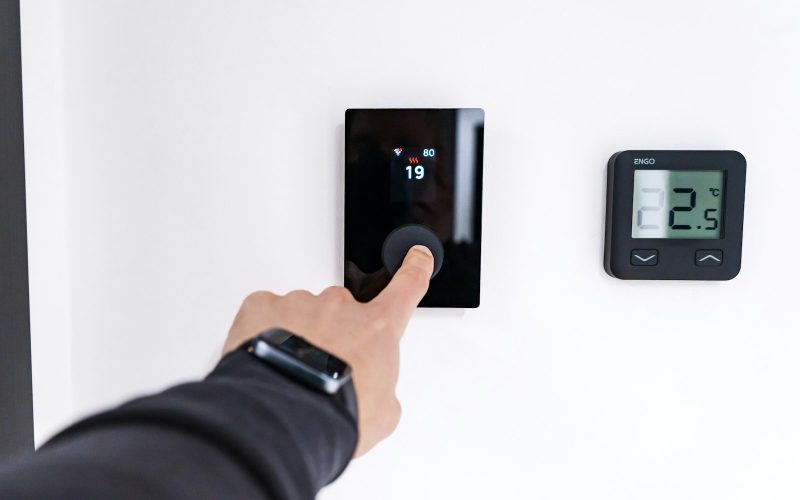
Alt text: “Thermostat display showing the auxiliary heat indicator lit during a heat pump heating cycle”
The actual difference, side by side
Both terms describe the same physical equipment: a bank of electric resistance heating elements, usually 5 to 20 kilowatts, sitting in the air handler downstream of the indoor coil. In a dual-fuel setup, the backup is a gas or propane furnace instead. What differs is who decides when that backup runs, and whether the heat pump keeps running at the same time.
| Auxiliary heat | Emergency heat | |
|---|---|---|
| Who turns it on | The thermostat, automatically | You, manually — by selecting EM HEAT |
| Is the heat pump still running? | Yes, it keeps working; the strips top it up | No, the compressor is locked out entirely |
| Typical trigger | Room is roughly 2°F or more below setpoint, or outdoor temp drops below a set threshold, or the system has run a while without closing the gap | A person deciding the heat pump should not run |
| How often it should happen | Occasionally in cold weather — normal and expected | Rarely. Many homes go their whole life without needing it |
| Relative running cost | Higher than heat pump alone, but blended | Highest possible — 100% resistance heat |
| Thermostat display | “AUX HEAT” or “AUX” appears while it’s active | “EM HEAT” stays displayed until you change the mode back |
| What to do about it | Nothing, unless it’s running constantly — then investigate | Only use it when the heat pump cannot safely run, and call for service |
Auxiliary means “assisting” — the heat pump is still doing most of the work and the strips are helping. Emergency means “instead of” — the heat pump is out of the picture. If you remember only one thing from this page, remember that emergency heat turns your efficient equipment off.
There is one more practical difference worth knowing. In many systems, selecting emergency heat also triggers an alert light or a service reminder, precisely because the manufacturer expects it to be a fault condition rather than a comfort preference. If your thermostat has been sitting on EM HEAT since last February and nobody noticed, that light is trying to tell you something.
Auxiliary heat is your system helping itself. Emergency heat is you telling it to stop trying.
— the distinction that saves people the most money
Why backup heat costs so much
The gap comes down to one number: coefficient of performance, or COP. It is simply how many units of heat you get out per unit of electricity you put in.
Electric resistance heat has a COP of about 1.0. Every watt of electricity becomes one watt of heat. That sounds like perfect efficiency, and in a narrow sense it is — nothing is wasted. But it is also the ceiling. You can never get more heat out than the electricity you paid for.
A heat pump does not create heat. It moves heat that already exists in the outdoor air into your house, and moving is far cheaper than making. In typical U.S. winter conditions a modern heat pump delivers a COP somewhere between 2 and 4 — two to four units of heat per unit of electricity. That is the whole reason heat pumps exist, and our guide to SEER2, HSPF2 and COP goes deeper into how those numbers are measured.
The catch is that COP falls as it gets colder. There is less heat in 10°F air than in 45°F air, so the compressor works harder for less return. A unit that hits COP 3.5 at 47°F might be at 2.2 around 17°F and closer to 1.7 at 5°F. Even at 1.7, though, it is still nearly twice as good as the strips. That single fact is why running the heat pump plus a bit of aux almost always beats running the strips alone.
Auxiliary heat exists for good reasons. It covers the coldest hours a system was not sized to handle alone, it warms the supply air during defrost cycles so you don’t get a blast of cold air, and it keeps the house from falling behind after a power outage. Occasional aux operation in winter is normal, expected engineering. It only becomes a problem when it runs far more than it should.
What it looks like on a bill
Numbers make this concrete. Below is an illustration, not a measurement. It assumes a house that needs 30,000 BTU per hour of heat on a cold night, and electricity at 18 cents per kilowatt-hour, which is roughly the U.S. residential average in 2026. Your own rate may be 13 cents or 50 cents depending on where you live, so scale accordingly.
| Heat source | Effective COP | Electricity drawn | Cost per hour | Cost for 24 hours |
|---|---|---|---|---|
| Heat pump alone, mild cold (~45°F out) | 3.0 | 2.9 kW | $0.53 | $12.65 |
| Heat pump alone, harder cold (~25°F out) | 2.0 | 4.4 kW | $0.79 | $19.00 |
| Heat pump + aux, half the heat from strips | 1.33 blended | 6.6 kW | $1.19 | $28.50 |
| Emergency heat — resistance strips only | 1.0 | 8.8 kW | $1.58 | $38.00 |
Read the first and last rows together. Same house, same comfort, same 30,000 BTU/h delivered. Three times the cost. Leave a system on emergency heat for a two-week cold spell and you have added several hundred dollars to a bill for no comfort benefit at all — because the house is exactly the same temperature either way.
That blended middle row is worth dwelling on too. Even when aux heat is carrying half the load, the total is still meaningfully cheaper than pure emergency heat, because the heat pump is doing the other half at better than 1:1. The compressor earns its keep right down to very low temperatures.
The classic story: a homeowner flips to EM HEAT during a January cold snap “to help the system out,” forgets about it, and gets a February bill two or three times normal. If your bill jumped and nothing else changed, check the thermostat mode before you call anyone.
The table is arithmetic, not a measurement: 30,000 BTU/h divided by 3,412 BTU per kWh gives 8.8 kWh of heat per hour, then divided by each COP to get the electricity drawn, then multiplied by 18 cents. Swap in your own rate and your own COP and the ratios hold. What does not change is the ranking — the heat pump is always the cheapest source it can be.
For a fuller picture of what heat pumps cost to buy and run against other options, see heat pump costs in 2026 and heat pump versus furnace.
What the aux / EM HEAT light means
Thermostats label these two states differently, which adds to the confusion. Here is how to read yours.
“AUX HEAT” or “AUX” appearing during a heating cycle means the strips are running right now, alongside the heat pump. It comes and goes. Seeing it during a 15°F morning is normal. Seeing it flash on for a couple of minutes during a defrost cycle is normal — the system is warming the supply air so you don’t feel a cold draft while the outdoor coil melts its frost. Seeing it lit for hours at 40°F outside is not normal.
“EM HEAT” displayed as the system mode means someone selected emergency heat and the compressor is locked out. It does not come and go. It stays until a person changes it. On many thermostats it is also accompanied by a red indicator or an alert, because the manufacturer treats it as an abnormal state.
Some thermostats blur the line. A few older models label anything second-stage as “AUX,” and a handful of smart thermostats show a small flame or “heating +” icon instead of the word. If you are not sure what your display is telling you, the model’s manual is the place to check — and it is worth knowing before a cold night, not during one.
Pick a normal winter week and glance at the thermostat a few times a day, noting when AUX is lit and what the outdoor temperature is. If AUX only appears below your balance point and during defrost, your system is behaving. If it appears at 45°F, or every single morning at 6 a.m., you have found something worth fixing.
Smart thermostats make this far easier. Most log runtime by stage, so you can see exactly how many hours of aux heat you used last month and at what outdoor temperatures. That report is the single most useful diagnostic tool a heat pump owner has, and it is free.
When emergency heat is the right call
There is a real use for the setting. It exists so you can keep your house warm when the heat pump genuinely cannot run — and running the compressor when it shouldn’t can turn a repair into a replacement.
Legitimate reasons to switch to emergency heat:
- The outdoor unit is physically damaged. A tree limb came down on it, a vehicle hit it, the fan blade is bent, or the cabinet is crushed. Running it risks destroying the compressor.
- The outdoor coil is encased in solid ice and defrost is not clearing it. Light frost that clears in a normal defrost cycle is fine. A unit that looks like a block of ice, with the fan frozen in place, needs the compressor off and a technician out.
- The compressor has failed or is making grinding, screeching or hard-start noises. Our noise guide covers which sounds are normal and which mean stop.
- A technician told you to. Some faults — a leaking reversing valve, a failed defrost board, a suspected refrigerant leak — are safest handled with the compressor locked out until the part arrives.
- A refrigerant leak is suspected. Running a system low on charge can burn out a compressor. Systems built since 2025 use A2L refrigerants (R-454B or R-32) which are mildly flammable; leak handling belongs to an EPA-certified professional.
In every one of these cases, emergency heat is a bridge to a service call, not a destination. Set it, call a licensed technician, and switch back to HEAT once the system is repaired. Expect the bill to be high for however many days it takes.
The fins and the refrigerant tubing behind them puncture easily, and a punctured coil turns a repair bill into a replacement bill. Switch to emergency heat, clear snow from around the unit, and let a technician deal with the ice. Do not pour hot water over it either — the refreeze usually makes things worse.
When people reach for it wrongly
Now the other list. These are the reasons people actually give for switching to emergency heat, and none of them hold up.
“It’s really cold out.” This is the most common one and the most expensive. Cold weather is when your heating demand is highest, which means it is precisely when the efficiency of your heat source matters most. Switching off a heat pump running at COP 2 and replacing it with strips at COP 1 during the coldest week of the year is the worst possible timing. The system was designed to handle cold weather by blending in aux heat automatically. Let it.
“The house isn’t warming up fast enough.” Emergency heat will not warm your house faster in any meaningful way, because the strips were already available to the thermostat as auxiliary heat. All you have done is remove the compressor’s contribution. In many systems the total output actually drops when you switch to EM HEAT, because you lose the heat pump’s share.
“The outdoor unit is steaming and making noise.” That is a defrost cycle. The system briefly runs in reverse to melt frost off the outdoor coil, which produces steam, a whooshing sound and sometimes a brief pause in warm air. It is completely normal, it lasts a few minutes, and it happens several times on a damp, cold day. Our explainer on how heat pumps work covers the defrost cycle in detail.
“There’s frost on the outdoor coil.” Light frost in cold, damp weather is expected. The system clears it on its own schedule. Only ice that covers the whole unit and never clears is a problem.
“I read it’s a good idea overnight.” It is not. Whatever you read was probably about a furnace, or was simply wrong.
People flip to emergency heat when the forecast turns severe, which feels protective. It is the equivalent of switching your car into its least efficient gear right before the longest drive of the year. Leave the thermostat in HEAT and let the system stage aux in as needed.
Balance point, and how it gets set
Balance point is the outdoor temperature at which your heat pump’s output exactly matches your home’s heat loss. Above it, the heat pump alone can hold your setpoint. Below it, something has to help.
For a typical air-source heat pump in a typical American house, the balance point lands somewhere around 30 to 40°F. For a well-insulated home with a properly sized cold-climate unit, it can be down in the teens or lower. For a leaky older house with an undersized system, it might be 45°F, which means aux heat runs a lot more than the owner expects.
Two things determine it: how much heat your house loses at a given outdoor temperature, and how much heat your unit can produce at that same temperature. That is why correct sizing is the foundation of the whole conversation. A load calculation done properly gives your installer both curves, and the point where they cross is your balance point.
Where it shows up in settings is the auxiliary heat lockout — an outdoor temperature above which the thermostat is simply not allowed to use the strips. If your balance point is 32°F, there is no scenario above roughly 40°F where resistance heat helps you, so locking it out saves money with zero comfort cost. Many installations ship with no lockout configured at all, meaning the strips are theoretically available at 55°F.
What is my balance point, and what is my aux lockout set to? A good installer will have both, and if the lockout is unset or set far above the balance point, ask them to fix it. Our companion guide on heat pump thermostat settings covers the other settings worth confirming at the same time.
One more nuance: some thermostats and utilities distinguish a thermal balance point (where capacity meets load) from an economic balance point (where the heat pump stops being cheaper than the backup fuel). For an all-electric system those are effectively the same, since the strips are always more expensive. For dual-fuel, they can be quite different — which brings us to the next section.
Dual-fuel systems and switchover
A dual-fuel or hybrid system pairs a heat pump with a gas or propane furnace instead of resistance strips. The thermostat picks whichever makes sense based on outdoor temperature. Above the switchover (or changeover, or crossover) temperature, the heat pump runs. Below it, the heat pump locks out and the furnace takes over.
Here the “emergency heat” setting means something slightly different: it runs the furnace alone, with the compressor locked out. And because a modern gas furnace is a far more capable backup than a strip heater, the cost penalty is smaller — but it is still not free, and it still means you are not using your cheapest heat source.
Where should switchover be set? Honestly, it depends on your gas price, your electricity price and your equipment, and defaults are frequently wrong. Surveys of thermostat products have found factory defaults anywhere from 35°F to 50°F, and contractor defaults often land around 35°F. Those numbers were reasonable for a single-stage heat pump in an era of cheap gas. With a variable-speed cold-climate heat pump and today’s rates, the crossover often belongs much lower.
| Setup | Reasonable starting switchover | Adjust if |
|---|---|---|
| Single-stage heat pump + natural gas furnace | 30–40°F | Gas is expensive where you live — go lower |
| Cold-climate variable-speed heat pump + gas furnace | 15–30°F | These units hold good COP well into the 20s and often lower |
| Heat pump + propane or oil | Often lower than gas | Delivered fuels are usually pricier per unit of heat than piped gas |
| Any setup on a time-of-use electric rate | Varies by hour, not just temperature | Some smart thermostats can factor in rate schedules |
The honest answer is that the ideal switchover is a math problem involving your two fuel prices and your unit’s capacity curve, and it changes when rates change. If your utility raised electric rates 10% this year, last year’s setting is no longer optimal. It is worth revisiting every couple of years rather than setting once and forgetting.
Alt text: “Outdoor heat pump unit operating normally in light snow with a clear coil and no ice buildup”
Is your aux heat running too much?
Occasional aux heat is normal. Constant aux heat is a symptom. Here is how to tell the difference and what usually causes it.
Signs your aux is running more than it should:
- The AUX indicator is lit at outdoor temperatures well above 40°F
- It comes on every single morning during your recovery period
- Your smart thermostat’s runtime report shows aux hours approaching or exceeding compressor hours
- Your winter electric bill is dramatically higher than neighbors with similar homes and similar equipment
- The system runs constantly and still never quite reaches setpoint
The usual causes, roughly in order of how often we see them:
Too aggressive a thermostat setback
The most common and the easiest to fix. A deep overnight setback means an eight-degree gap at 6 a.m., which is a direct invitation to the strips. Shrink the setback to 2–4°F or flatten the schedule entirely. Details in our thermostat settings guide.
No aux lockout configured
If nothing tells the thermostat “don’t use strips above 40°F,” it will use them whenever it sees a gap, even on a mild day. Ask your installer to set one based on your balance point.
Restricted airflow
A clogged filter, a dirty indoor coil, closed registers or crushed ductwork all reduce heat delivery. The room stays cold, the thermostat sees a gap, and it calls for aux. Start with the maintenance checklist — a $20 filter fixes this surprisingly often.
Low refrigerant charge
A system losing refrigerant loses capacity, so it falls behind sooner and calls for backup more. This needs a technician to diagnose by superheat and subcooling, and a leak has to be found and repaired, not just topped up.
A failed sensor or control board
A bad outdoor temperature sensor can make the thermostat think it’s 10°F when it’s 40°F. A failed defrost sensor can leave the coil frosted, killing capacity. Both are technician jobs and both produce exactly this symptom.
The system is undersized for the house
If the unit was sized for a smaller heat load than the house actually has — or the house got a poorly insulated addition — the heat pump simply cannot keep up and aux fills the gap all winter. This is the hardest and most expensive cause to fix. Our cold-climate heat pump roundup covers units that hold capacity where standard models fade.
Work down that list in order. The first three are things you or your installer can address in an afternoon. The last three need a technician with gauges. What you should not do is accept a high aux runtime as “just how heat pumps are,” because it usually isn’t.
Refrigerant charge, electrical work at the air handler or disconnect, aux heat staging on the equipment side, and any diagnosis involving gauges are licensed-technician territory. Capacitors hold a charge after the power is off, strip heaters run on 240 volts, and refrigerant handling requires EPA Section 608 certification. Filters, registers, snow clearance and thermostat settings are yours.
6 mistakes that cost real money
❌ Mistake 1: Switching to EM HEAT during a cold snap
It feels like helping. It is the opposite. You have turned off the efficient heat source during the hours you need the most heat, and replaced it with the least efficient one. In some systems total output actually goes down, so the house may even be less comfortable.
❌ Mistake 2: Leaving it on EM HEAT after the repair
A technician comes out in December, tells you to run emergency heat until the part arrives, fixes it a week later, and nobody changes the thermostat back. The system happily runs on strips for the rest of the winter and the owner finds out from the bill.
❌ Mistake 3: Mistaking a defrost cycle for a failure
Steam pouring off the outdoor unit, a whooshing sound, and a minute or two of cooler supply air look alarming the first time. People assume the unit is broken and flip to emergency heat.
❌ Mistake 4: Treating constant aux heat as normal
The AUX light is on most of the winter, the bill is brutal, and the owner concludes heat pumps just don’t work well in their climate. Often the real cause is a dirty filter, a missing lockout setting, or a setback schedule left over from a furnace.
❌ Mistake 5: Setting the dual-fuel switchover at the factory default
A 45 or 50°F default hands most of the winter to the furnace, which was a defensible choice for a 15-year-old single-stage heat pump but wastes the capability of a modern variable-speed unit that is still efficient in the 20s.
❌ Mistake 6: Chipping or hosing ice off the outdoor coil
A frozen unit looks like something you can fix with a hammer or a kettle. Coil fins bend at a touch and the refrigerant tubing behind them punctures easily, which converts a service call into a coil replacement.
Frequently asked questions
What’s the difference between auxiliary heat and emergency heat?
Auxiliary heat turns on automatically and runs alongside the heat pump when the heat pump alone can’t keep up. Emergency heat is a manual mode you select on the thermostat that shuts the heat pump off entirely and runs the backup by itself. They use the same equipment — resistance strips, or the furnace in a dual-fuel system — but auxiliary keeps the efficient compressor working while emergency heat does not.
Should I use emergency heat when it’s really cold outside?
No. Cold weather is when running on pure resistance heat is most expensive, because your heating demand is at its highest. Your system already blends in auxiliary heat automatically when it needs to, while keeping the heat pump contributing. Reserve emergency heat for a heat pump that physically cannot run — damaged, iced solid, or a failed compressor.
How much more does emergency heat cost?
Roughly two to three times what the heat pump costs for the same amount of heat, because resistance heat has a COP of about 1.0 while a heat pump typically runs between 2 and 4 depending on outdoor temperature. In our illustration above — 30,000 BTU/h at 18 cents per kWh — that’s about $38 a day on emergency heat versus about $13 a day on the heat pump in mild cold. Your actual figures depend on your electricity rate and climate.
Is it bad if my aux heat comes on?
Not by itself. Auxiliary heat exists to cover the coldest hours, to warm supply air during defrost cycles, and to help after a power outage. Occasional operation in genuinely cold weather is normal engineering. It becomes a problem when it runs at mild outdoor temperatures, every morning during recovery, or for a large share of total runtime.
What is a balance point and why does it matter?
It’s the outdoor temperature where your heat pump’s output exactly matches your home’s heat loss. Above it the heat pump can hold your setpoint alone; below it something has to help. Typical values run around 30 to 40°F, lower for a well-insulated home with a cold-climate unit. It matters because it tells you where the auxiliary heat lockout should be set — above your balance point, strip heat is pure waste.
Why is my outdoor unit steaming? Should I switch to emergency heat?
Steam, a whooshing noise and a brief pause in warm air mean the system is running a defrost cycle, which reverses operation for a few minutes to melt frost off the outdoor coil. It’s normal and happens several times on a cold, damp day. Don’t switch to emergency heat. Only if defrost runs longer than about 15 minutes, repeats every few minutes, or the coil stays encased in ice should you lock out the compressor and call for service.
My dual-fuel system runs the furnace all winter. Is that right?
Possibly not. Factory and contractor defaults for switchover temperature often land between 35 and 50°F, which hands most of the season to the furnace. With a modern variable-speed heat pump that stays efficient well into the 20s, a lower switchover often saves money. The right number depends on your gas and electric rates and your unit’s capacity curve, so ask your installer to calculate it rather than accepting the default.
Your checklist
✅ Your checklist
- Know which is which — aux is automatic and runs with the heat pump; EM HEAT is manual and shuts the heat pump off
- Check your thermostat mode right now — if it says EM HEAT and nothing is broken, change it to HEAT
- Don’t use EM HEAT for cold weather — that’s the most expensive possible time to run pure resistance heat
- Do use it for a damaged, iced-solid or failed outdoor unit — then call a licensed technician the same day
- Learn your balance point — and make sure the aux lockout is set above it
- Track aux runtime for one week — a smart thermostat’s runtime report is the best free diagnostic you have
- If aux runs above 40°F outside — check filter, setback schedule and lockout before assuming the equipment is bad
- Dual-fuel owners: revisit the switchover temperature — defaults are often far too high for modern equipment
- Never chip or hose ice off the coil — the fins and tubing puncture easily
- Flatten deep winter setbacks — see our thermostat settings guide for the full set
Sources
- Lennox — What is the difference between Emergency Heat and Auxiliary Heat?
- U.S. Department of Energy — Heat Pumps
- DOE Building Science Education — Thermostats for Heat Pumps and Dual-Fuel Heat Pumps
- California Energy Commission — Dual Fuel Heat Pump Thermostat Settings (default changeover temperatures)
- U.S. Energy Information Administration — Electric Power Monthly, average residential price

Heat Pump Reviews Editorial Team
Our editors research heat pumps full time: manufacturer specifications, AHRI and ENERGY STAR listings, published cold-climate performance data, warranty terms, installer feedback and owner reviews. We do not accept payment for placement, and every rating follows our published methodology.